
Progressive Lens Tiers Compared: Standard, Premium and Elite
Progressive lenses come in tiers. Standard uses simpler, often moulded designs with narrower clear zones. Premium and elite use freeform surfacing tuned to your prescription, frame and habits, giving wider, cleaner vision and easier adaptation. Pay up for strong prescriptions, small frames or first-time wearers.
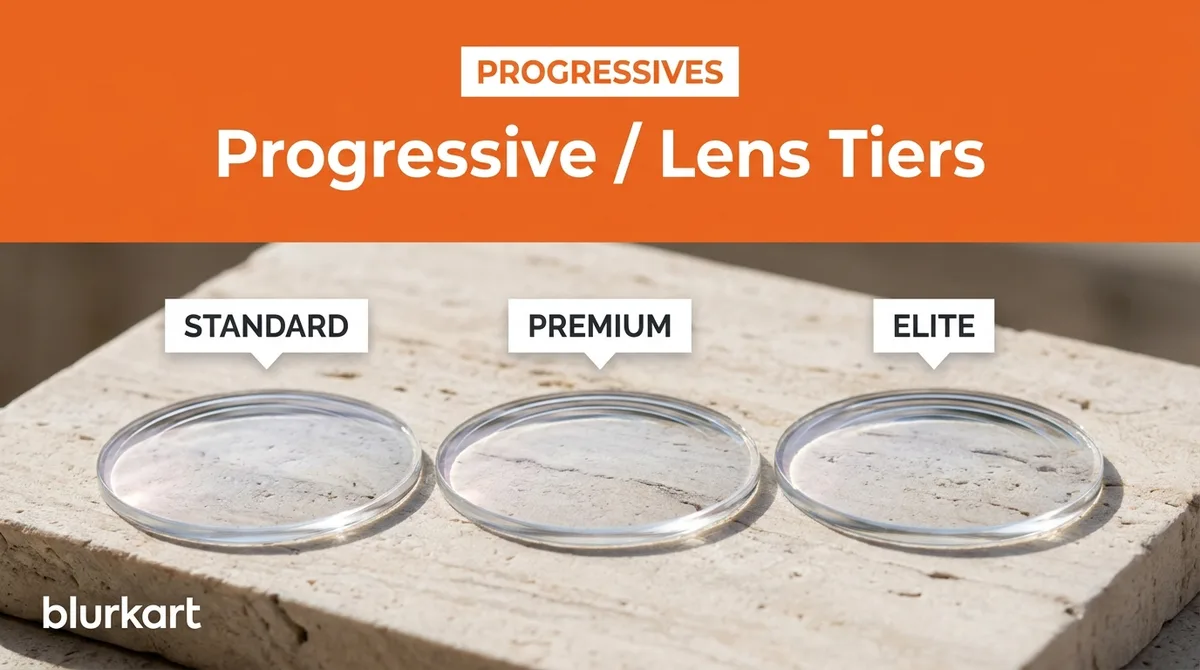
Why one progressive costs far more than another
Shop for progressive lenses and you will meet a confusing spread of prices for what sounds like the same product. The secret is that progressives come in tiers. They all do the same job, blending distance, intermediate and near vision into one lens, but how well they do it, and how comfortable they feel, climbs with the tier.
Standard tier
Entry progressives often use simpler, frequently moulded designs with a fixed pattern. They work, and for a mild prescription and an experienced wearer they can be fine. The trade-offs:
- A narrower clear corridor, so more head movement to find the sweet spot.
- More noticeable distortion at the sides.
- Little or no tailoring to your specific frame.
Premium tier
Premium progressives are freeform: the surface is computed and surfaced to your exact prescription and frame. This widens the clear corridor, softens the side distortion, and makes adaptation easier. For most daily wearers, this is the sweet spot of price and performance.
Elite tier
Elite designs push freeform further, often accounting for how you hold your phone, tilt your head and move through the day, plus top-grade coatings. The gains are real but subtler, and they matter most for demanding users, very small frames or strong prescriptions.
The tiers at a glance
| Tier | Design | Clear corridor | Best for |
|---|---|---|---|
| Standard | Simpler, often moulded | Narrow | Mild Rx, experienced, budget |
| Premium | Freeform to your Rx + frame | Wide | Most daily wearers |
| Elite | Freeform + habits + top coatings | Widest, softest | Strong Rx, small frames, demanding users |
Where the money is best spent
The jump most people actually feel is from standard to premium. The jump from premium to elite is real but subtle, and worth it mainly for heavy or demanding users.
So if budget is tight, put your money into reaching a good premium freeform lens with a quality coating before chasing the top tier.
Choosing your tier in Nepal
Match the tier to your life, not just your eyes. A retiree reading and watching TV has different needs from a coder on screens all day or a shopkeeper glancing between a ledger and the street. Bring an accurate prescription, describe your daily tasks honestly, and ask what tier, material and coating each quote includes. Then pick the lowest tier that comfortably covers how you actually use your eyes.
Coatings usually travel with the tier
Tiers are not only about the corridor. Higher tiers almost always bundle better anti-reflective and scratch-resistant coatings, which affect glare, cleaning and durability as much as the optics do. When you compare quotes, remember you may be comparing a basic coating against a premium one, not just two corridor widths. A mid tier with an excellent coating can be a better daily experience than a higher tier with a cheap one.
A sensible way to choose your tier
- Start from your life: how many hours on screens, how much driving, how small is your preferred frame?
- Pick the lowest tier that comfortably covers those tasks; for most people that is premium freeform.
- Go elite only if you have a strong prescription, a tiny frame, or a history of struggling with progressives.
- Always protect the budget for a good coating; it is felt every single day.
Spending more is not the same as buying better. The goal is the right tier for how you actually use your eyes, not the top of the price list.
Frequently asked
- Is an elite progressive lens worth the extra money?
- For heavy users, small fashion frames, strong prescriptions or anyone who struggled with progressives before, the widest, softest elite designs can be worth it. For a mild prescription and general daily use, a premium tier is usually plenty.
- What do I actually get by paying more for progressives?
- Mainly a wider clear corridor, softer peripheral distortion, a design tuned to your frame and habits, and a better anti-reflective coating. You are buying comfort and usable vision area, not a different prescription.
- Will a cheaper progressive still work?
- Yes, especially for mild prescriptions and experienced wearers. The trade-off is a narrower sweet spot and more head movement to find it. First-time wearers often find cheaper tiers harder to adapt to.
- How do I compare progressive quotes fairly?
- Ask each shop for the design tier, the lens material and index, and the coating included. Two quotes that look far apart often include different tiers and coatings, so line those up before comparing the price.
- Do tiers matter more for strong prescriptions?
- Yes. The stronger your prescription, the more distortion a lens has to manage, so a higher freeform tier makes a bigger difference to comfort and clarity.