
Sunglasses for driving on the Prithvi Highway
For a long Nepali highway drive, choose grey polarised lenses in category 2 or 3. Grey keeps traffic-light and signal colours true, polarisation kills the glare off wet tarmac and the river. Never wear tinted lenses after dark, and never use category 4 for driving, it is too dark to be legal or safe.
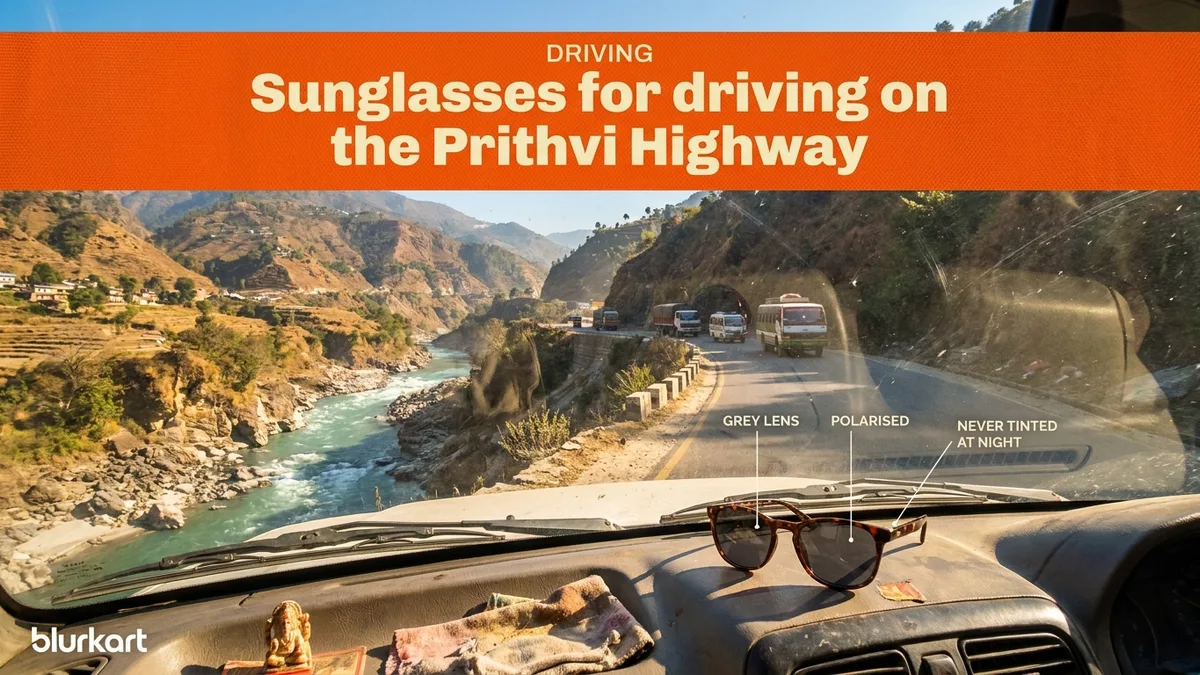
Choosing sunglasses for driving a long Nepali highway is a harder problem than choosing beach sunglasses, because the light changes every few minutes. Bright gorge, deep tree shade, a tunnel, then low sun straight down the valley.
What sunglasses for driving actually need to do
Four things, in order.
Keep colours true. Traffic signals, brake lights and indicator amber all have to read correctly and instantly. This is why grey is the standard recommendation: it dims everything evenly rather than shifting the palette. Brown and amber lift contrast, which is useful on a trail and slightly risky when a signal colour is the information you need.
Cut reflected glare. On a wet road after monsoon rain, or alongside the Trishuli with the sun on the water, the glare is horizontally polarised. A polarised lens removes most of it. This is the single biggest comfort difference on a four-hour drive.
Not be too dark. Lens categories run 0 to 4. Category 2 is a general tint, category 3 is proper bright-sun. Category 4 is for glaciers and high altitude and is too dark to drive in, legally in many places and practically everywhere.
Handle the transitions. Coming out of a tunnel into bright gorge light, or into deep shade under trees, your eyes need to adapt fast. Too dark a lens slows that down badly.
What we would put you in
Grey, polarised, category 3, in a frame with thin temple arms so it sits comfortably against a headrest and under a cap. Wraparound helps on the stretches where the sun comes in from the side.
If you wear a prescription, this is the strongest case in Nepal for a second pair as prescription sunglasses rather than clip-ons, because clip-ons rattle and get lost at exactly the moment you need them. Prescription sunglasses covers the options and which colour and how dark goes into the tint choice.
Two things to avoid
Photochromic inside a car. They darken in response to ultraviolet, and a windscreen blocks most UV. So the lens that goes properly dark on a footpath stays disappointingly light behind the wheel. Some are engineered to activate behind glass; ordinary ones are not. How fast they darken has the honest timings.
Any tint after dark. This one is worth being blunt about. Tinted lenses at night remove light you need to pick out an unlit pedestrian or a parked truck, and Nepali highways have plenty of both. If oncoming headlights smear, the answer is a clear lens with a proper anti-reflective coating, not a darker one.
The polarisation trade-off
Polarised lenses can make LCD dashboard displays and a mounted phone go dark or show rainbow patterns, because both emit polarised light. If you navigate from a fixed phone mount, test before you buy. Polarised lenses and phone screens explains why, and rotating the phone usually solves it.
Before a long drive
Clean the lenses properly and clean the inside of the windscreen, which scatters more light than most people realise. Keep the sunglasses in a hard case in the door rather than on the dashboard, where heat crazes the coating in a season.
Bring any pair to either showroom and we will test the UV filter free on a meter, including pairs bought elsewhere. Every sunglass we sell is UV400 from NPR 999, with polarised options marked, in the sunglasses range.
The rest of the glare problem
Lenses handle part of it. The vehicle handles more than people expect.
Clean the inside of the windscreen. A film of dust and vinyl residue scatters light across your whole field and is the single most underrated cause of daytime glare. It also makes night driving worse, for the same reason.
Use the sun visor rather than a darker lens. A visor blocks the source without removing light from the road.
Keep the sunglasses in a hard case in the door pocket, not on the dashboard. A dashboard in May reaches temperatures that craze a lens coating and warp an acetate frame within a season, and that damage is not covered by any warranty.
If you already wear glasses, the honest recommendation for a regular highway driver is a dedicated prescription sunglass rather than clip-ons, because clip-ons rattle, scratch the main lens and get left at tea stops.
Frequently asked
- Are photochromic lenses good for driving?
- Not inside a car. They darken in response to UV, and a windscreen blocks most UV, so they stay much lighter than they would outdoors. Some lenses are made specifically to activate behind glass; ordinary ones are not.
- What about night driving glare?
- Never a tint. Use a clear lens with a good anti-reflective coating, which is the layer that stops oncoming headlights smearing across your lens. Any tint at night removes light you need.
- Prithvi Highway ma gaadi chalauna kasto sunglass ramro?
- Grey rang ko polarised lens, category 2 ya 3. Grey le batti ra signal ko rang badalidaina. Polarised le bhijeko sadak ra khola ko chamak hataunchha. Rati chai kunai pani tinted lens nalagaunus.