
Which sunglasses shape suits your face?
Match the frame shape to contrast with your face: angular shapes on a round face, curved shapes on a square face, most things on an oval face. But check width first, because a frame wider than your temples slides down all day regardless of how well the shape suits you.
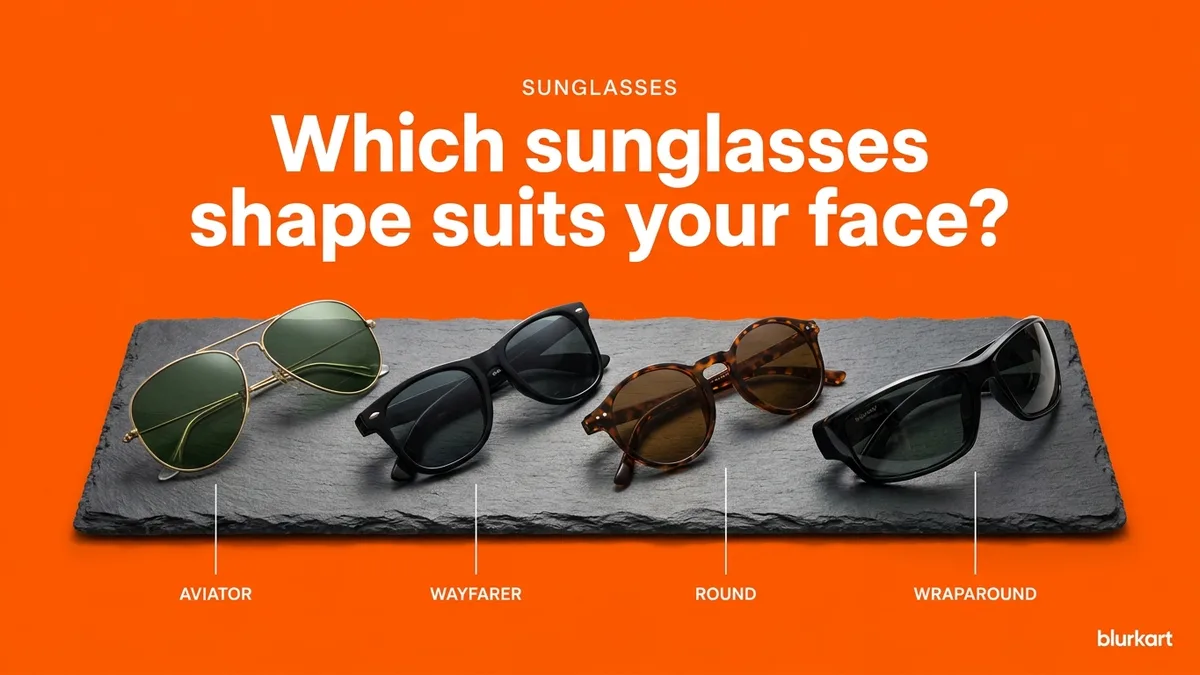
Working out which sunglasses shape suits your face is usually presented as a style quiz. It is simpler than that, and the single most important check is not shape at all.
Check width before you check shape
Put the frame on and look straight into a mirror. The outer edge of each lens should line up with the widest part of your face at the temples, or sit just inside it.
Wider than that and the arms have nothing to grip. The whole weight lands on your nose, the pair walks downward all day, and you push it back up every few minutes until you stop wearing it. No adjustment fixes a frame that is simply too wide.
This is why aviators fail on a lot of Nepali faces despite suiting the shape: the classic sizes are cut wide. The shape was never the problem. The numbers inside the arm tell you the width before you try it on.
Then match shape by contrast
Round face, similar width and length with soft edges. Add definition with angular shapes: wayfarers, rectangles, or an aviator with a defined brow bar. Avoid small round frames, which echo the face and flatten it.
Square face, strong jaw, similar width at cheek and jaw. Soften with curves: round frames, ovals, or a classic teardrop aviator. A hard rectangular frame doubles the angles you already have. Cat-eye for a square jaw covers the upswept option.
Oval face, longer than wide, balanced. Most shapes work, so choose on coverage, colour and comfort. Very large frames can overwhelm a narrow oval.
Heart face, wider at the forehead and narrower at the chin. Shapes with visual weight at the bottom balance it: aviators, round frames, and rimless bottoms. Avoid heavy top bars, which add to the wide part.
Shapes by what they actually do
Style aside, the shapes differ functionally.
Wraparound gives the most coverage, because it curves with your face and blocks light arriving from the sides. For trekking, high altitude or snow this beats every other consideration, and the trekking guide explains why.
Aviator covers well downward, which suits driving where glare comes off the bonnet and the road.
Wayfarer is a good all-rounder in acetate, which survives being thrown in a bag better than thin metal.
Small round looks excellent and protects least, because there is simply less lens area and large gaps at the sides.
The part that is not about shape at all
Whatever you pick, the lens decides whether the purchase was worth making. UV400 is the specification that protects your eyes, and it is unrelated to how dark or how stylish the lens is. Polarisation is a separate comfort feature that is excellent for driving and awkward with phone screens.
Every sunglass we sell carries a UV400 lens, starting at NPR 999, and we will test any pair you already own free on a UV meter at either showroom. Try the shapes on in daylight rather than under shop lighting, and browse the range or the men's and women's edits.
Which sunglasses shape suits your face: a two minute method
Stand in front of a mirror in daylight, not shop light. Put the frame on and check three things in order: does the frame reach past your temples, do your pupils sit near the centre of each lens, and does the bottom rim touch your cheeks when you smile. Fail any of those and the shape does not matter.
Then take a photo. A mirror shows you a reversed face you have learned to like, and a photo shows what other people see, which is the more honest test for anything distinctive.
Finally, try one deliberately larger and one deliberately smaller alongside the pair you like. The comparison tells you far more than any single frame does, and it is the quickest way to learn whether you want the shape or only the idea of it. Styling is free at both showrooms with no obligation to buy, and we will measure your face width first so the shortlist only contains frames that will actually stay on. Bring the sunglasses you already own too: knowing which pair you stopped wearing, and why, narrows the choice faster than any face-shape chart.
Frequently asked
- Do aviators suit everyone?
- Close to it, which is why they persist. The teardrop is slightly curved and slightly angular at once, so it does not fight any face shape hard. The catch is size: aviators are often too wide for narrow faces.
- What shape covers the most from the sun?
- A wraparound. Side coverage is the part flat frames miss, and light coming in at the temples is a real chunk of your exposure at altitude or near snow. That matters more than shape for trekking.
- Mero anuhaar lai kun sunglass suhauchha?
- Golo anuhaar bhaye wayfarer jasto kuna bhayeko, chauko anuhaar bhaye golo ya aviator. Tara sabbhanda pahila chaudai herus: frame anuhaar bhanda chaudo bhayo bhane dinbhari khaskinchha.