
What is Pupillary distance and how to measure it at home
Pupillary distance is the distance between the centres of your pupils in millimetres, usually 58 to 68 for adults. Lenses are centred on it, so a wrong PD makes glasses feel pulling or tiring even when the power is right. You can measure it at home with a ruler and a mirror.
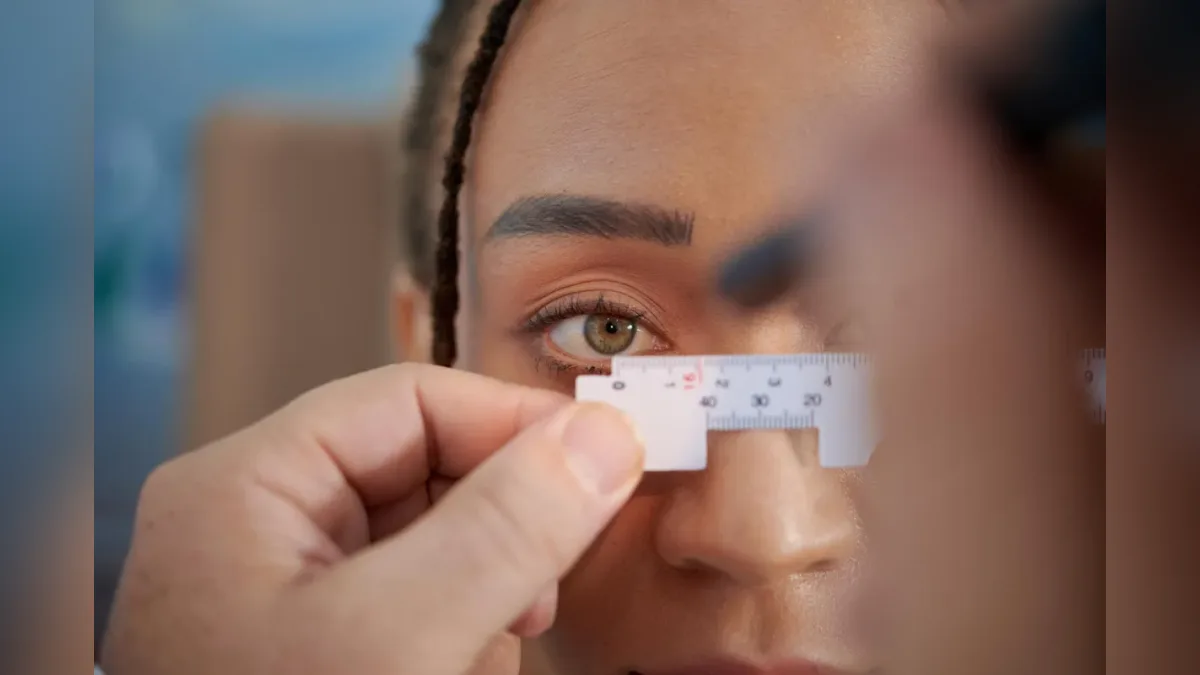
Pupillary Distance (PD) is the distance between the centers of your pupils, measured in millimeters. This measurement is crucial when ordering prescription glasses online, because it ensures that the optical center of your lenses aligns perfectly with your eyes.
PD is essential for:
- Clear vision, Properly aligned lenses reduce strain and provide sharp vision.
- Comfort, Incorrect PD can lead to headaches, dizziness, or eye fatigue.
- Optimal lens performance, Especially important for multifocal or progressive lenses.
There are two main types of PD:
- Single PD, A single measurement that represents the distance between your pupils. Most people use this when ordering standard glasses.
- Dual PD (or Monocular PD), Separate measurements for each eye, from the center of your nose to each pupil. This is commonly used for stronger prescriptions or advanced lenses.
Why is Pupillary Distance Important?
Many people focus on frame style, lens quality, or price when buying glasses, but PD is equally important. Even if your prescription is perfect, the wrong PD can make your glasses uncomfortable or reduce the effectiveness of your lenses.
Some problems caused by incorrect PD include:
- Blurry or distorted vision
- Eye strain and headaches
- Trouble focusing, especially with digital screens
- Discomfort during long hours of wear
By ensuring your PD is correct, your glasses not only look good but also provide maximum clarity and comfort.
How to Measure Pupillary Distance at Home
You don’t need a trip to the optometrist to get your PD. Here are some simple, accurate ways to measure it at home.
Method 1: Using a Mirror and Ruler
What you need:
- A millimeter ruler (preferably with 1 mm increments)
- A mirror
Steps:
- Stand about 18 inches from the mirror.
- Hold the ruler against your brow, aligning the zero mark with the center of one pupil.
- Close your right eye and align the zero mark with the center of your left pupil.
- Open both eyes and read the measurement in millimeters.
- Repeat a few times for accuracy and take the average.
Use a ruler with millimeter markings for precision. Make sure your eyes are level and looking straight ahead.
Method 2: Using a Friend
What you need:
- A millimeter ruler
- A friend to help
Steps:
- Sit or stand facing your friend.
- Ask your friend to hold the ruler against the bridge of your nose.
- Look straight ahead and have your friend measure the distance from the center of one pupil to the other.
- For monocular PD, measure from the center of the nose to each pupil individually.
- Record the measurements and repeat to ensure accuracy.
Method 3: Using a Smartphone App
Several apps now allow you to measure PD using your phone camera. Many online eyewear retailers also provide tools that guide you through capturing your PD with a selfie.
Steps:
- Download a reliable PD measurement app.
- Follow the instructions, usually involving taking a clear, straight-on photo of your face.
- The app calculates your PD automatically.
- Double-check the measurement using another method for accuracy.
Why Accurate PD Matters for Online Eyewear
With the rise of online eyewear stores, many people order glasses without visiting an optometrist. Your PD is one of the most crucial measurements for online purchases. Without it, your lenses may not align properly, affecting:
- Vision clarity
- Eye comfort
- Frame fit and style
Common Questions About Pupillary Distance
Q1: Can I use the same PD for all my glasses?
A: Generally yes, but for progressive lenses or stronger prescriptions, monocular PD is recommended for optimal clarity.
Q2: Does PD change over time?
A: PD can change slightly as you grow, especially in children. For adults, it usually remains stable.
Q3: Is PD important for sunglasses?
A: While sunglasses are often less precise than prescription glasses, correct PD still ensures comfort and reduces eye strain, especially for polarized or high-index lenses.
Measuring your PD at home allows you to order glasses confidently from platforms like Blurkart, or other online optical stores in Nepal.
Pupillary Distance (PD) is a small measurement with a big impact. Whether you’re ordering online glasses in Nepal or picking out a new pair of stylish sunglasses, knowing your PD ensures comfort, clarity, and style.
By following simple methods, using a ruler and mirror, asking a friend, or using a smartphone app, you can measure your PD accurately at home. Pair this with the right frames and lenses, and your eyes will thank you with sharp, comfortable vision every day.
So next time you pick a trendy frame or order your favorite designer glasses online, don’t forget to measure your pupillary distance first, it’s the key to seeing better and looking your best!
The PD is one number on a slip full of them, and our guide to reading your eyeglass prescription explains the rest. If a wrong PD is why your current pair tires you out, headaches behind the eyes covers how to tell. New lenses go into your existing frame, or into something light like the Premium Rectangle Frame at NPR 1,200.
If you would rather not measure it yourself, we take your PD in about a minute at either showroom. It is part of the free eye test, and there is no obligation to buy anything.
When measuring pupillary distance at home is not enough
The mirror and ruler method gets most adults within a millimetre or two, which is fine for a mild prescription. It stops being fine in three cases.
A strong prescription, past about minus 4, where a two millimetre error shifts the optical centre enough to cause eye strain by evening. Progressive lenses, which need a fitting height as well as a PD, and that cannot be measured at home at all. And children, who will not hold still enough for the reading to mean anything.
We measure PD free at either showroom in about a minute, whether or not you buy from us. Reading your prescription covers the other numbers on the slip.
Frequently asked
- What is a normal pupillary distance?
- Adults are usually between 58 and 68 mm. Children are lower and it changes as they grow, which is one reason children need yearly checks.
- What happens if my PD is wrong?
- The optical centre of each lens sits off your pupil, so your eyes work against a slight prism all day. The result is a pulling feeling and headaches by afternoon.
- Can Blurkart measure my PD?
- Yes, free, in under a minute at either Lalitpur showroom, whether or not you bought the glasses from us.
- PD ko matlab ke ho, ghar mai napna milchha?
- PD is the gap between the centres of your two pupils in millimetres, and most adults fall between 54 and 74 mm. You can measure it at home with a ruler and a mirror, but we measure it free at either showroom in about a minute and that is the more accurate number to cut lenses from.