
Polarised lenses and phone screens: why the display goes black
LCD phone screens emit light that is already polarised in one direction. A polarised lens blocks light in the other direction. Hold the phone in landscape while wearing the glasses and the two cross, so the screen darkens or blacks out. It is physics, not a defect, and rotating the phone fixes it.
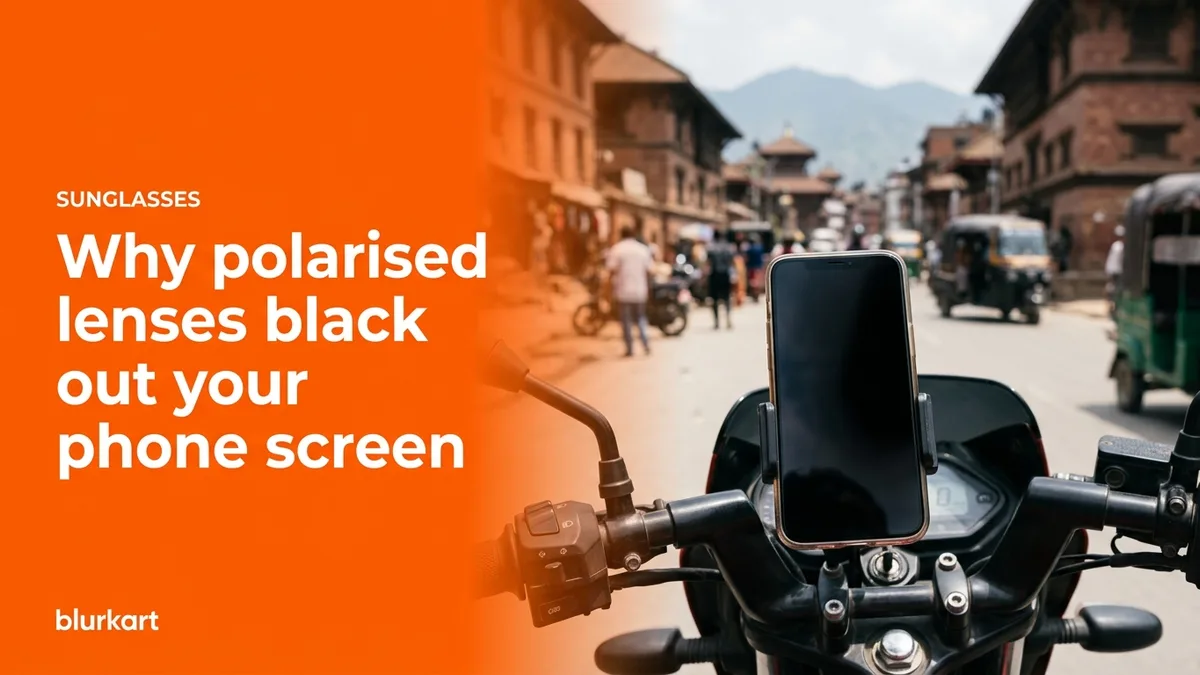
You put on polarised sunglasses, glance at your phone in landscape, and the screen is black. Polarised lenses and phone screens fight each other for a reason that is entirely predictable once you know what each one is doing.
Why polarised lenses and phone screens conflict
Ordinary daylight vibrates in every direction at once. A polarising filter only lets through light vibrating in one plane, blocking the rest. That is how sunglasses kill glare: light bouncing off a flat surface like wet road or water becomes strongly horizontal, and a lens tuned to block horizontal light removes it.
An LCD screen works by sandwiching liquid crystals between two polarising filters. So the light leaving your phone is already polarised, in one fixed direction set by the manufacturer.
Now you are looking at polarised light through a polarising filter. If the two happen to line up, the picture is fine. If they sit at ninety degrees to each other, almost nothing gets through and the screen goes black.
Most phones put their filter at forty-five degrees precisely so this is less likely in portrait. Turn the phone to landscape and you rotate it into the crossed position.
What to do about it
Rotate the phone ninety degrees. That is the whole fix, and the picture returns immediately.
Tilt your head instead if the phone is mounted. Same effect, other end of the problem.
Check whether your phone is OLED. OLED panels do not rely on the same polariser sandwich, so they are far less affected. This is why a new handset can seem fine while the dashboard in the same car still goes dark.
For a bike with a mounted phone, test before you buy. Take your phone to the shop, mount position and all, and look through the lens at the angle you will actually use. Two minutes there beats discovering it on the Prithvi Highway.
Where it genuinely matters
Car dashboards are the common complaint in Nepal, particularly digital instrument clusters and infotainment screens. Fuel pump displays, ATM screens and some parking meters do it too.
Riders using a phone for navigation are the group most affected, because the phone is fixed in one orientation and you cannot rotate it mid-journey. If that is you, this is the single best reason to think twice about polarised.
Pilots avoid polarised lenses outright, both for instrument displays and because polarisation can hide stress patterns in a windscreen.
So should you still buy polarised?
For most people in Nepal, yes. Wet monsoon roads, snow at altitude and the glare off a river are exactly what polarisation is for, and the comfort difference on a long drive is large.
Skip it if you spend your day reading mounted screens, or buy a non-polarised UV400 pair for riding and keep a polarised pair for everything else.
What you should not do is skip UV400. Polarisation is a comfort feature. UV filtering is the protective one, and they are separate properties. UV400 or polarised explains the difference, and how to spot a fake polarised lens uses this same screen effect as the test.
Every sunglass we sell is UV400 from NPR 999. Bring your phone to either showroom and test a polarised pair against it before you decide. Browse the range here.
Testing before you buy
Take your phone to the shop and check the pair against it at the angle you will actually use. If you ride with a phone mounted on the handlebar, hold the phone in that orientation rather than in your hand, because the mounted angle is the one that fails.
Check a car dashboard too if you can. Digital instrument clusters vary a lot, and some go noticeably dark where others are fine.
If the result is bad and you still want polarised, the workable answer is two pairs: non-polarised UV400 for riding and screen-heavy days, polarised for driving, water and snow. Sunglasses start at NPR 999 here, so that is a smaller decision than it sounds. What is not negotiable either way is UV400, which is the part that protects rather than the part that flatters. We will read any pair on a UV meter free at either showroom, including one bought elsewhere, and tell you plainly if there is no filter in it.
Frequently asked
- Are my sunglasses faulty if the screen goes dark?
- The opposite. It is proof they are genuinely polarised. A fake polarised lens shows no darkening at any angle, which is exactly the test people use to check authenticity.
- Which screens are worst?
- LCD, including most car dashboards, fuel pumps, ATMs and many older phones. OLED phone screens are affected much less, which is why newer handsets often seem fine while a dashboard still goes dark.
- Polarised chasma lagauda mobile ko screen kaalo kina hunchha?
- Mobile ko screen bata aune ujyalo euta dishama matra hunchha ra lens le arko dishako roknchha. Duitai kaatiyo bhane screen kaalo dekhinchha. Mobile lai nabbe degree ghumaunus, turantai dekhinchha. Yo bigreko hoina.