
Astigmatism explained without the diagram
Astigmatism means the front of your eye is curved more in one direction than another, so light focuses at two points instead of one. It shows up on your prescription as CYL and AXIS. It is extremely common, it is not a disease, and a lens corrects it completely once you adapt over a few days.
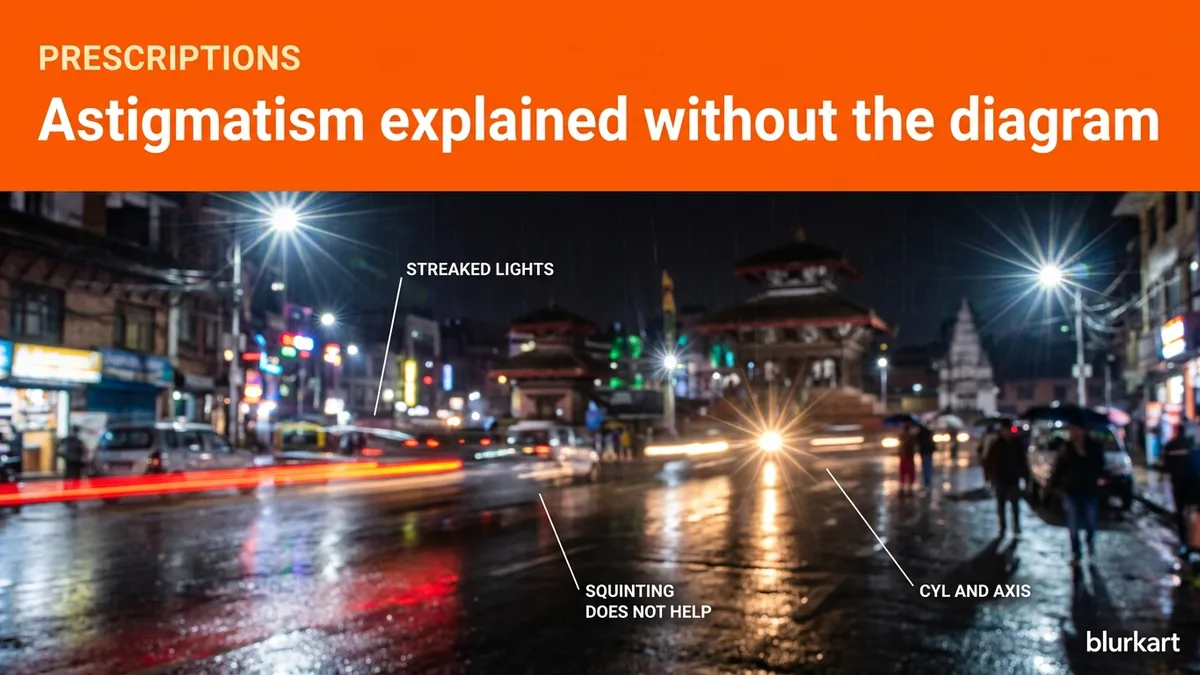
Every explanation of astigmatism starts with a diagram of a cornea and loses people by the second sentence. Here is one without it.
What astigmatism actually is
A well-behaved eye is curved like the surface of a football. Equally round in every direction. Light hits it, bends once, and lands in a single sharp point at the back.
An eye with astigmatism is curved more like a rugby ball. Steeper across one direction than the other. Light coming in gets bent by different amounts depending on which way it enters, so instead of landing at one point it lands at two. Your brain gets two slightly different versions of the same edge and blends them into something soft.
That is the whole thing. Not a disease, not damage, not something you did. A shape.
What it feels like
Blur that does not improve much when you squint, which is the giveaway. Short-sightedness gets a bit better when you narrow your eyes. Astigmatism mostly does not.
Streetlights and headlights grow little tails or starbursts at night. Text looks slightly doubled or shadowed rather than simply fuzzy. Some directions of line look sharper than others, so a vertical pole looks fine and the horizontal wires look soft, or the reverse. And a lot of low-level eye ache by late afternoon, because you have been unconsciously working to resolve something that will not resolve.
Reading it on your slip
Two columns tell you. CYL is the amount, and like SPH it can be minus or plus. Under about 0.75 most people are not bothered by it. Above that it is usually worth correcting.
AXIS is the direction, written as a number between 1 and 180. It is not a strength. It is an angle, telling the lab which way round to place the correction. An axis of 180 is horizontal, 90 is vertical.
Here is the practical bit. If your slip has a CYL number but the AXIS box is blank, the prescription is incomplete and cannot be made up. Take it back and ask. We see this on eye camp slips fairly often, and it is the one thing that genuinely has to be corrected at the source. Our full walkthrough of reading an eyeglass prescription covers every other box on the slip.
Why the first few days feel odd
This catches people out, especially with a first astigmatism correction or a change in axis. For the first two or three days, floors can look slightly tilted, doorframes lean, and the ground seems closer or further than it is. Some people feel briefly queasy on stairs.
That is not a mistake in the lens. Your brain has spent years quietly compensating for the distortion, and you have just removed it. The compensation takes a few days to unlearn. Wear them full time from the first morning rather than switching back and forth, because alternating stretches it out.
If it is still wrong after a week, come back. Genuinely wrong axis exists and we would rather recheck than have you persevere with something that does not suit you.
What corrects it
Glasses, with a cylindrical component ground into the lens at your axis. There is no extra charge for that at Blurkart: single vision lenses start at NPR 750 with a blue coat and NPR 1,800 multi-coated, whether or not you have astigmatism.
Contact lenses can too, using toric lenses that are weighted to keep their rotation on your eye. Those cost more than a standard lens for exactly that reason, and they need a proper fitting rather than just your glasses numbers.
Astigmatism generally changes slowly, so once corrected you are unlikely to see dramatic shifts year to year. A check every two years is enough for most adults. The eye test is free at both showrooms and takes about ten minutes, and you can browse prescription frames from NPR 999 while you are there.
Does it get worse?
Usually not quickly. Astigmatism is mostly set by the shape of your cornea, and that shape is fairly stable through adult life. Small drifts of 0.25 or 0.50 over several years are normal and often not worth remaking glasses for. What is worth attention is a noticeable jump in a short period, or astigmatism that appears for the first time in an adult who never had it, because that is worth an ophthalmologist looking at the cornea rather than just a new lens.
Frequently asked
- Is astigmatism a disease?
- No. It is a shape, like being tall. Almost everyone has a small amount. It does not spread, it is not caused by reading in bad light, and it usually changes very slowly.
- Can astigmatism be corrected with contact lenses?
- Yes, with toric lenses, which are weighted so they stay in the right rotation on your eye. They cost more than standard lenses because that orientation has to hold.
- Astigmatism bhaneko ke ho?
- Aankha ko agadi ko bhag euta dishama badhi ra arko dishama kam gholo hunchha, tyasaile prakash duita thaun ma padchha ra dhamilo dekhinchha. Prescription ma CYL ra AXIS lekhieko hunchha. Chasma le thik parchha.