
ZEISS UVProtect: Why 400 nm UV Protection Matters
ZEISS UVProtect is a technology built into clear plastic ZEISS lenses so they block UV rays up to 400 nm, the same level as premium sunglasses. Industry standard ISO 8980-3 only requires clear lenses to reach 380 nm, leaving a gap. ZEISS made UVProtect standard in clear lenses from 2018 and chose not to patent it.
Quick answer
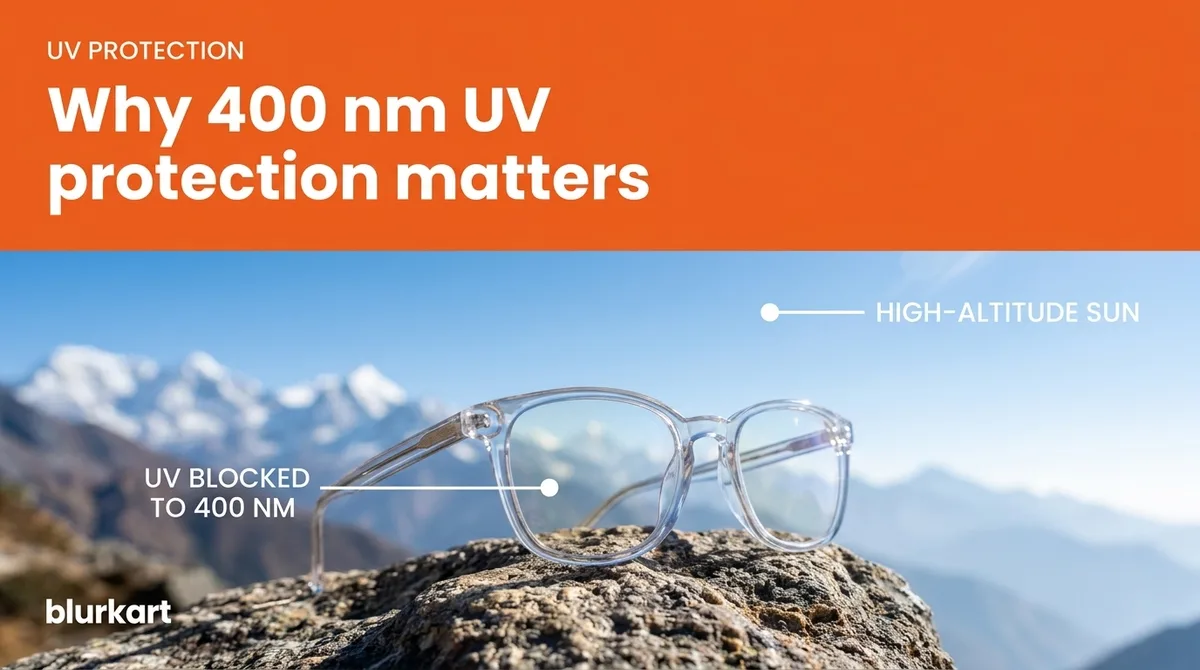
ZEISS UVProtect blocks UV rays up to 400 nm in clear plastic lenses, the same level as premium sunglasses. The common industry standard for clear lenses stops at 380 nm.
Most of us think about UV only when we buy sunglasses. But UV exposure continues behind clear lenses, and not all clear lenses protect equally.
The gap between 380 and 400 nm
The ISO 8980-3 standard requires clear spectacle lenses to protect up to 380 nanometres. The World Health Organization, among others, defines the need to block UV up to 400 nm. That leaves a 20 nm band where many clear lenses allow UV through. ZEISS has said this gap exposes many wearers to a meaningful share of the more harmful rays.
How UVProtect closes it
ZEISS modified the chemistry of its clear lens materials so that they absorb UV across the full spectrum up to 400 nm, without changing how the lens looks or how much visible light passes through. Because the protection is part of the material, rather than a dye or coating, ZEISS says it lasts for the life of the lens. Under a UV camera, a clear UVProtect lens appears dark because the UV is completely blocked.
ZEISS introduced UVProtect across its clear plastic lens range in 2018 and decided not to patent it, so that other lens makers could use the idea too.
Protection from the back as well
UV can also bounce off the back surface of a lens into your eye. ZEISS DuraVision coatings include back-surface UV protection, so combined with UVProtect the lens delivers what ZEISS calls complete, sunglass-level protection from all sides.
Why this matters in Nepal
At high altitude the atmosphere filters less UV, so exposure is higher in places like Kathmandu valley, Pokhara and the trekking regions than at sea level. Clear lenses with full UV protection are a simple, always-on safeguard, especially for children who spend long hours outdoors.
How to check your own glasses
- Ask your optician what UV rating your lenses have, and whether it is stated as up to 380 nm or 400 nm.
- Look for UV400 or UV protection up to 400 nm in the product description and on your invoice.
- Many opticians can test lenses with a UV meter, so ask whether yours can.
Do not assume that lens colour indicates UV protection. A very dark lens can lack UV filtering, and a perfectly clear lens can block it fully.
Curious about your current glasses? Book a free eye test at Blurkart and ask us to check your options.
Information is based on ZEISS materials and public industry reporting. UV protection levels vary by lens brand and material.
Frequently asked
- What does UV400 mean?
- It means the lens blocks ultraviolet light up to a wavelength of 400 nanometres, which covers essentially all UVA and UVB rays.
- Do all clear lenses block UV?
- Not fully. The industry standard ISO 8980-3 requires clear lenses to protect only up to 380 nm, which leaves a gap between 380 and 400 nm.
- Does ZEISS UVProtect make the lens look tinted?
- No. ZEISS modified the clear lens polymer so that it absorbs UV without noticeably changing visible light transmission or the look of the lens.
- Do coatings add to UV protection?
- Yes. ZEISS says its DuraVision coatings reduce UV reflections from the back surface, which together with UVProtect gives complete sunglass-level protection.
- Is UV protection only needed in sunny weather?
- UV is present year-round, and in high-altitude places such as Kathmandu and the Himalayan treks it can be stronger. That is why UV protection is worth having in everyday clear lenses too.