
Why Outdoor Time Slows Myopia (and How to Fit It Into a School Day)
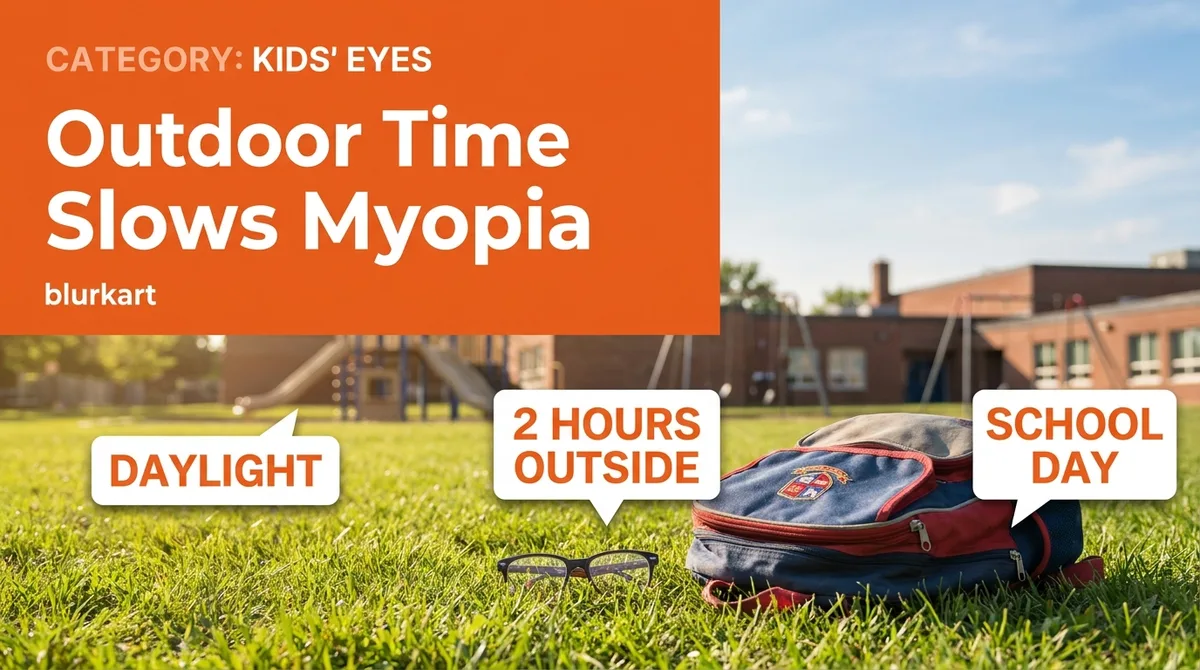
Spending two or more hours a day outdoors in daylight is strongly linked to slower myopia progression in children. Bright natural light and frequent distance viewing both help. It is free, carries no side effects, and works alongside glasses, control lenses or atropine.
The one protection that costs nothing
Among all the ways to slow a child's rising eye power, one stands out for being free, side-effect-free, and backed by strong evidence: time outdoors in daylight. It is also the one most easily lost to tuition classes, homework and smartphones, which is exactly why it is worth protecting on purpose.
Why daylight helps
Myopia develops when the eyeball grows a little too long. Bright natural light appears to influence the signals that regulate that growth, helping to keep it in check. Natural daylight is also vastly brighter than indoor lighting, often by ten times or more, even on a cloudy day. On top of that, being outside naturally means looking into the distance rather than at a book or screen held close, which relaxes the focusing system.
It is the light that does the work, not the sport. A child reading on a sunny balcony is getting more protection than one studying under a bright lamp indoors.
How much is enough
The practical target from research is around two hours of daylight a day, spread across the week rather than crammed into the weekend. It does not need to be structured exercise. Walking to school, outdoor play, sport, or simply sitting outside all count, as long as it is in natural light.
Fitting it into a Nepali school day
- Walk part of the commute rather than being dropped at the gate.
- Move breaks outside: tiffin and short study breaks on a balcony, terrace or courtyard.
- Protect playtime: resist filling every free hour with indoor tuition.
- Weekend daylight: a morning outdoors before screens take over.
- Pair it with the 20-20-20 habit during indoor study.
It works with everything else
| Measure | Role |
|---|---|
| Outdoor daylight | Prevention and slowing, free, no downside |
| Myopia control lenses | Active daily slowing while worn |
| Low-dose atropine | Added braking for fast progressors |
Outdoor time is the base layer. Whatever else your child uses, more daylight only adds to the effect.
The takeaway for parents
You cannot stop a growing eye from changing, but you can tilt the odds. Two hours of daylight a day is a realistic, no-cost habit that genuinely slows myopia, and it happens to be good for sleep, mood and general health too. In a culture of heavy study, treating outdoor time as non-negotiable is one of the smartest things you can do for your child's eyes.
Common myths about outdoor time
- "It has to be sport." No. Quiet time in daylight counts; it is the light and distance that help, not the exertion.
- "Cloudy days do not count." They do. Overcast daylight is still far brighter than indoor lighting.
- "Sunglasses cancel the benefit." The benefit is linked to bright light reaching the eyes, so ordinary outdoor exposure is what matters; do not keep a child indoors for fear of this.
- "Once myopia starts, outdoor time is pointless." It still slows further progression.
Making it stick as a family habit
Habits survive when they are built into the day, not added on top of it. Walk part of the school run, eat an outdoor snack, keep one weekend morning for the park before screens, and let younger siblings join so it becomes normal for everyone. If you track anything, track daylight minutes rather than steps. Protecting two hours a day sounds like a lot until you realise how much of it can come from commuting, breaks and ordinary play, simply moved outside.
Frequently asked
- How much outdoor time does a child need to slow myopia?
- Research points to roughly two or more hours of daylight a day, spread across the week. More is better, and it does not have to be sport; even walking or outdoor play counts, as long as it is in natural light.
- Does outdoor time reverse myopia?
- No. It helps delay the onset of myopia and slows progression, but it does not reverse existing power. Think of it as prevention and protection, used alongside any lenses or drops your child needs.
- Is it the exercise or the light that helps?
- The evidence points mainly to bright natural light and distance viewing, rather than exercise itself. So quiet outdoor time in daylight counts, not only active sport.
- Does outdoor time help if my child already wears glasses?
- Yes. It still slows further progression, and it combines well with control lenses or atropine. It is one of the few protective steps with no downside and no cost.
- What about Nepal's monsoon and winter?
- Even overcast daylight is far brighter than indoor lighting, so outdoor time still helps on cloudy days. In monsoon, use breaks between rain; in winter, the middle of the day offers the brightest light.