
Red eyes after contact lenses: harmless or a warning?
Mild redness that fades within an hour of taking lenses out is usually dryness, a lens worn too long, or a slightly poor fit. Redness with pain, light sensitivity, blurred vision or discharge is different and needs an eye doctor the same day. Colour alone tells you little; pain tells you a lot.
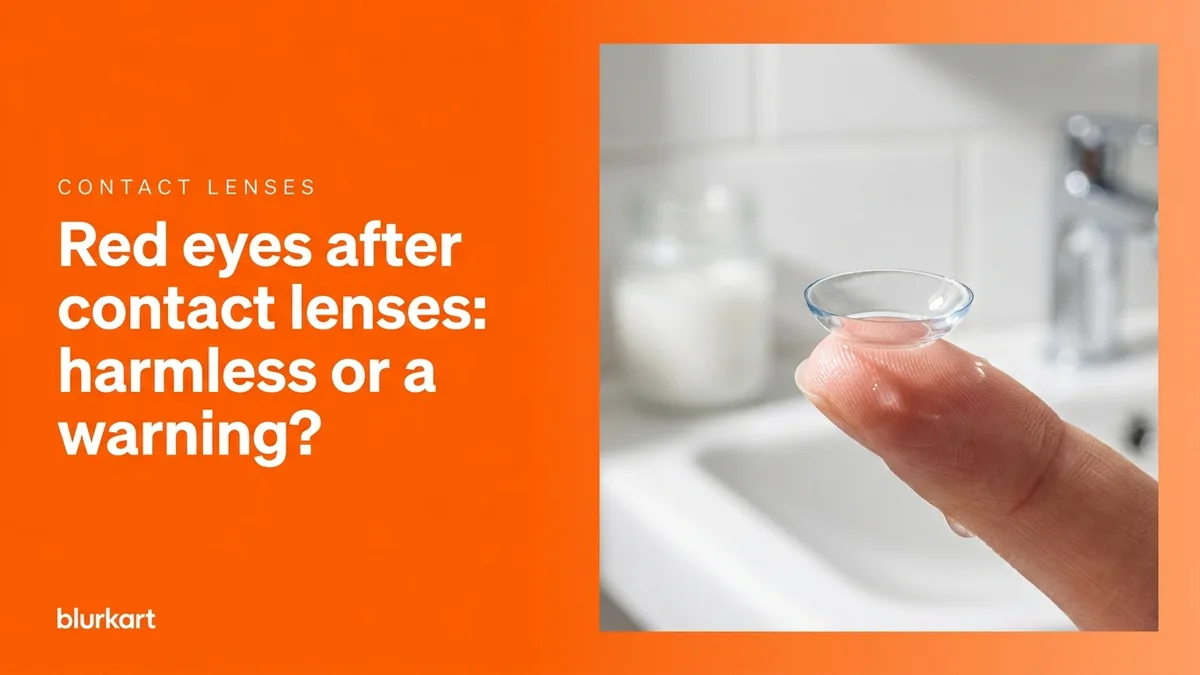
Red eyes after contact lenses cover a wide range, from completely ordinary to something you should act on today. The useful signal is not how red they look. It is whether they hurt.
Red eyes after contact lenses: the harmless version
You take the lenses out in the evening and the whites look pink. Nothing hurts, vision is normal, and within an hour the colour is gone. That is the common case and it usually means one of four things.
Dryness, which is the most frequent cause in Kathmandu. A lens sits in your tear film, and when the film thins the lens drags slightly on the surface. Dust and traffic fumes make it worse.
Overwear. Lenses worn 14 hours behave very differently from lenses worn 8. The cornea has been short of oxygen for the extra hours and responds by opening up surface blood vessels.
A tired lens. A monthly lens in week four holds protein deposits that make it rougher than a fresh one.
A slightly poor fit. A lens too tight moves badly, a lens too loose slides. Both irritate mechanically.
The version that is a warning
Redness with any of the following is a different conversation: genuine pain rather than grittiness, sensitivity to light, blurred vision, discharge, or redness that is still there the next morning.
Those point at a corneal problem, which can be an infection, an abrasion or an inflammatory reaction. Corneal infections can scar, and a scar over the pupil costs vision permanently. This is not something to sit out for a few days.
Redness in one eye only deserves more suspicion than both. Both eyes pink after a long day is usually environmental. One angry eye usually has a specific cause.
In either case: take the lens out and leave it out. Do not put a fresh lens in a red eye to get through work. Wear glasses, and if it is the warning version, go to an eye hospital the same day. We will tell you that at the counter rather than selling you drops.
What not to reach for
Redness-relief drops are the instinct and the wrong move. They work by constricting the blood vessels in the white of the eye, which removes the appearance of the problem while leaving the problem. They also produce rebound redness, so you end up using them more often. Worse, they mask the one sign that would have told you something was developing.
A preservative-free lubricating drop is the right thing to keep in a bag. It treats the commonest cause, which is dryness, and hides nothing.
Stopping the ordinary version
Cut the wearing time before you cut anything else. Ten hours instead of fourteen fixes a surprising amount, and glasses for the evening is not a defeat.
Replace on schedule. A monthly lens means thirty days from opening, not thirty days of wear. Never top up old solution in the case, and replace the case itself every month.
If dryness is the pattern, dailies often suit better than monthlies because every lens is fresh. Daily vs monthly covers the real cost difference, and dry eyes in the dry season covers the local version.
If redness happens every single day regardless, the fit is worth rechecking. That is free at both showrooms, and lenses start at NPR 1,100 for a six-lens pack if a change of material is the answer.
What we look at when you bring it in
A red eye tells us very little on its own, so the questions are about pattern. One eye or both. How long after putting the lens in. Whether it clears when the lens comes out. Whether vision changed. Whether it is painful or gritty, which are different sensations and point in different directions.
Then we look at the lens itself. A tiny nick in the edge, invisible to you, drags with every blink and reddens one eye reliably. A lens that has gone stiff late in its month does the same. Bring the actual lens and its case, not just the eye.
If anything suggests a corneal problem we stop and send you to an eye hospital rather than adjusting a fit. That is the right order, and it is free to be told so.
Frequently asked
- Can I use redness-relief drops with contact lenses?
- Avoid them. Those drops work by constricting blood vessels, which hides the sign without treating the cause, and rebound redness is common. A preservative-free lubricating drop is the right choice.
- Why is only one eye red?
- One-sided redness points to something specific to that eye: a damaged lens, trapped debris, a scratch, or an infection starting. It deserves more attention than both eyes being mildly pink.
- Contact lens lagayepachhi aankha rato bhayo, k garne?
- Lens nikalnus ra chasma lagaunus. Euta ghanta bhitra rato harayo bhane sukkha aankha ko karan ho. Dukhyo, ujyalo mann parena ya dhamilo dekhyo bhane tyo din nai aankha aspatal janus.