
Reading your contact lens prescription: BC, DIA and power
A contact lens prescription has BC (base curve, the lens curvature), DIA (diameter), PWR or SPH (the power), plus CYL and AXIS if you have astigmatism and ADD if you need reading correction. It also names a specific brand, because BC and DIA only mean anything within one product. Your glasses numbers are not enough to order lenses.
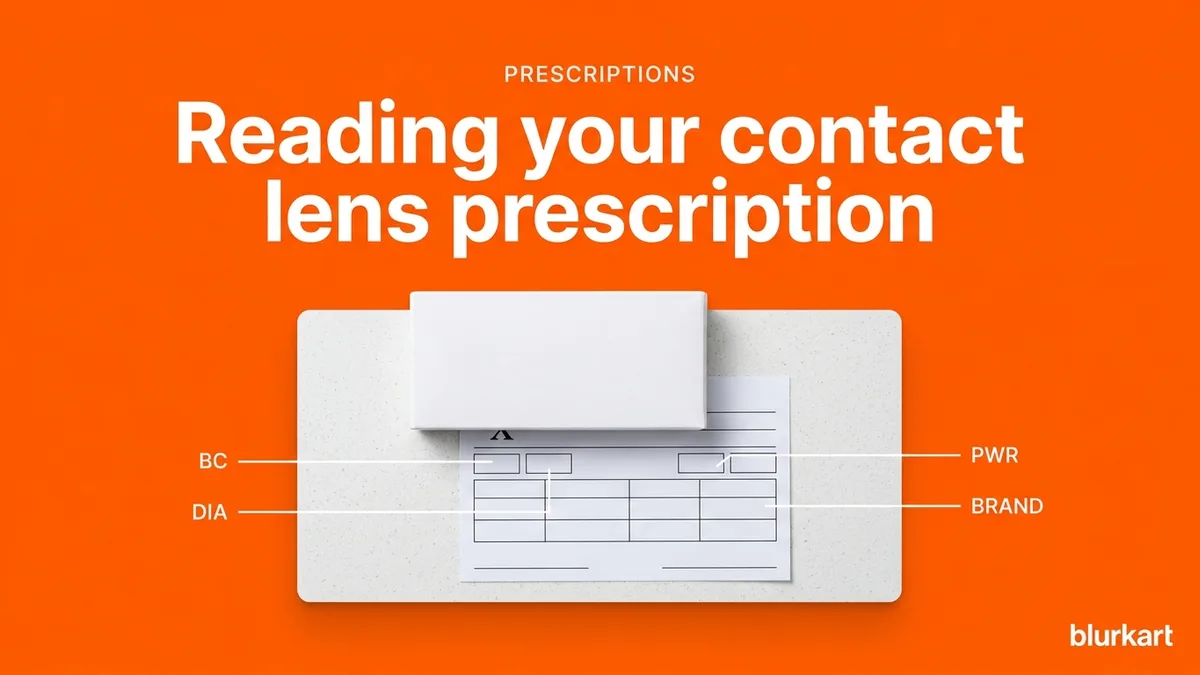
A contact lens prescription looks like a glasses prescription with extra codes bolted on. It is actually a different document describing a different object, and the differences are the important part.
What is on a contact lens prescription
BC, base curve. How curved the back of the lens is, in millimetres, typically 8.3 to 9.0. A lower number is a steeper lens. It has to roughly match the curvature of your cornea. Too steep and the lens grips and will not move, which starves the eye and traps debris. Too flat and it slides about, feels gritty and blurs as it shifts.
DIA, diameter. How wide the lens is, usually 13.8 to 14.5 mm. It decides how far the lens extends past your iris and affects both comfort and how well it centres.
PWR or SPH, power. The correction, with a minus sign for short-sighted and plus for long-sighted, in 0.25 steps.
CYL and AXIS. Only if you have astigmatism, and they mean the lens is toric. Toric lenses explains why those cost more.
ADD. Reading power, for multifocal lenses, usually after about 40.
Brand and name. Not decoration. BC and DIA only have meaning inside a particular product, because materials and edge designs differ. An 8.6 base curve in one brand does not behave the same as an 8.6 in another.
Why it differs from your glasses
Two reasons, and the second surprises people.
First, glasses sit about twelve millimetres in front of your eye. A contact lens sits directly on it. That gap changes the effective power of the same lens. For mild prescriptions the difference is negligible. Past about 4 dioptres it is large enough that a straight copy of your glasses number gives you the wrong lens, so it has to be compensated.
Second, glasses prescriptions carry no BC or DIA at all, because glasses do not touch your eye. Those two numbers come from measuring your cornea, and there is no way to derive them from a glasses slip. That is the whole answer to why you cannot order lenses from one.
Astigmatism adds a third difference: the axis for a toric lens is compensated for how the lens actually rotates on your eye, which is measured during the fitting.
Expiry, and why it is short
Contact lens prescriptions are typically valid for a year, shorter than a glasses prescription. That is not a sales mechanism. A lens is a medical device sitting on living tissue, and the fitting needs checking: corneal shape changes slightly, lenses tighten as your tear film changes, and early problems are visible to an optometrist long before you notice them.
Getting one
You need a contact lens fitting, not just an eye test. We measure your corneal curvature, try a trial lens, check how it moves and centres on your eye, and confirm your vision with it in. For toric lenses we also check where it settles.
That fitting is free at both showrooms, Pulchowk in Lalitpur and Boudha in Kathmandu, and you keep the prescription whether or not you buy here. Bring your glasses slip anyway, since it gives us a starting point. The full contact lens guide covers daily versus monthly, and lenses start at NPR 1,100 for a six-lens pack.
Keeping a copy that is actually useful
Photograph the prescription and the box your lenses came in, both. The prescription gives the numbers; the box gives the exact product name, which is the part people forget and which BC and DIA are meaningless without.
That matters when you reorder from anywhere, and it matters more if you run out while travelling. A shop in another city can match a product from a box photo in seconds and cannot do anything useful with a half-remembered brand.
Keep the expiry date in view too. Prescriptions for lenses run about a year, and an out-of-date one is not an administrative nuisance: the fit genuinely changes as your corneal shape and tear film change, and a lens that fitted last year can sit too tightly now. That is the whole reason for the shorter validity, and it is why a lens that felt perfect last season can feel tight or loose now without anything else having changed. The full contact lens guide covers the fitting itself.
Frequently asked
- Can I order contact lenses using my glasses prescription?
- No. A glasses prescription has no base curve or diameter, and those are measured against your eye. A lens that does not match your curvature either grips too tightly or slides around, and both cause problems.
- Why is my contact lens power different from my glasses power?
- A lens sits on the eye, glasses sit about twelve millimetres in front of it, and that distance changes the effective power. Past about 4 dioptres the difference is large enough that it has to be compensated for.
- Contact lens ko prescription ma BC ra DIA bhaneko ke ho?
- BC bhaneko lens kati gholo chha bhanne naap ho ra DIA bhaneko lens ko chaudai. Duitai aankha ma naapera nikalincha, chasma ko prescription ma hundaina. Tyasaile chasma ko number le matra lens order garna milddaina.