
Night blindness, or just bad street lighting?
True night blindness is difficulty adapting to low light, and it has real medical causes including vitamin A deficiency and retinitis pigmentosa. Most people complaining about night vision in Kathmandu actually have an outdated prescription, uncorrected astigmatism, glare from headlights, or early cataract, and the first three are straightforward to fix.
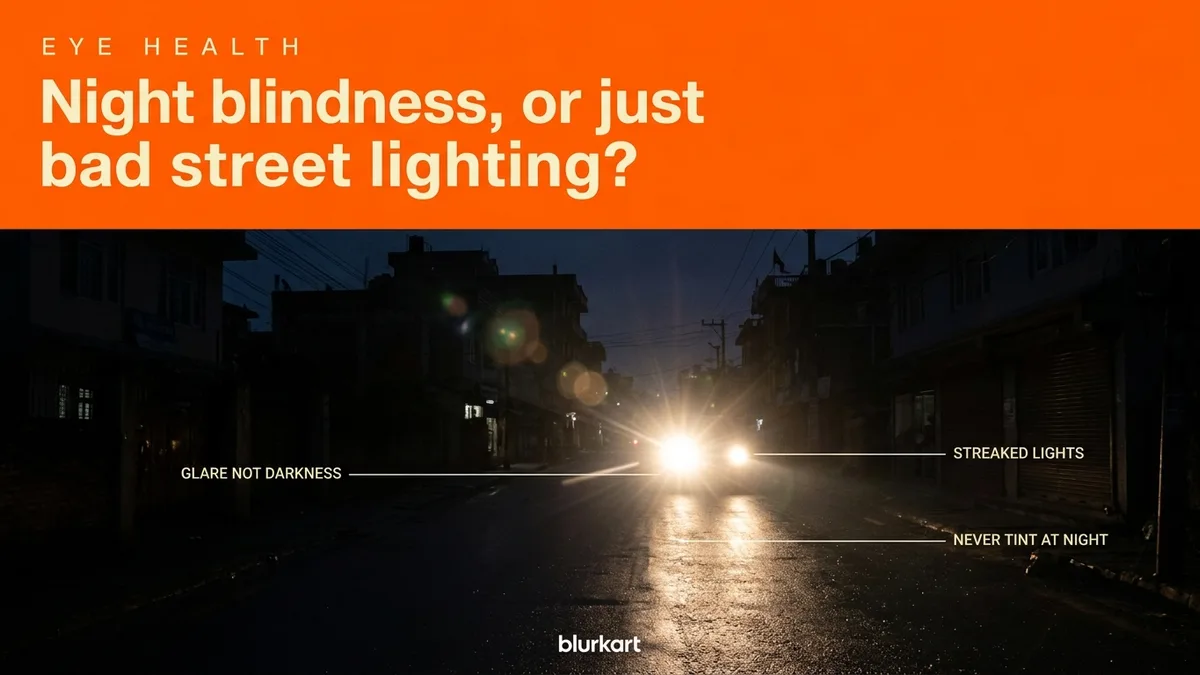
People say night blindness when they mean night driving has become unpleasant. Those are often different things, and in Kathmandu a good share of the complaint is genuinely the streets rather than the eyes.
What night blindness actually means
Medically, nyctalopia is difficulty adapting to low light. Walking from a lit room into a dark one and taking far longer than other people to start seeing shapes. Not being able to find a seat in a dark cinema when everyone else manages.
The rods in your retina handle low light, and they take about twenty minutes to fully adapt. If that process is impaired, you are functionally blind in conditions where others can see.
Real causes include vitamin A deficiency, which still occurs in parts of Nepal and is both testable and treatable; retinitis pigmentosa, an inherited retinal condition; advanced glaucoma; and significant cataract.
What most people actually have
An outdated prescription. Night is where a slightly wrong power shows first. Your pupil opens wider in the dark, which uses more of the periphery of your eye's lens, where blur is worst. A prescription that feels fine at noon can be clearly inadequate at 9pm.
Uncorrected astigmatism. The classic description is streaks, tails or starbursts radiating from every streetlight and headlight. If lights have spikes rather than being round, this is very likely it, and a lens corrects it completely. Astigmatism explained covers the numbers.
Glare, not darkness. This is the Kathmandu special. Oncoming headlights, many of them badly aimed or over-bright, flood your eye and wipe out the dark areas either side. You are not failing to see in the dark; you are being dazzled. An anti-reflective coating on your lenses makes a real difference here, because much of that smear is light bouncing around on your lens surfaces.
Early cataract. A clouding lens scatters light rather than focusing it, which shows up as halos around lights long before daytime vision blurs. If night driving got worse over a year or two and colours look slightly duller, this is worth checking. Cataract signs covers it, and cataract is treatable.
Actual bad lighting. Unlit lanes, no reflective markings, pedestrians in dark clothing and vehicles without working rear lights. Everyone is worse in those conditions. That is not your eyes.
The thing not to buy
Yellow-tinted night driving glasses. They are sold everywhere and they make things worse.
Any tint reduces the total light reaching your eye, and after dark light is the scarce resource. A yellow lens can increase subjective contrast while genuinely reducing your ability to pick out an unlit pedestrian or a stationary truck. Studies have found they do not improve night driving performance, and the potential harm is obvious.
What you want at night is a clear lens with a good multi-layer anti-reflective coating. That is the combination that reduces headlight smear without removing light you need. At Blurkart a multi-coated lens is NPR 1,800 against NPR 750 for a basic blue coat. Driving sunglasses covers the daytime side.
What to do
Start with an eye test, because three of the five causes above are found in ten minutes. It is free at both showrooms and carries no obligation.
If the test is clean and the problem persists, or if you genuinely struggle to adapt to darkness rather than just disliking headlights, that is an eye hospital referral rather than a new pair of glasses. We will say so.
Practical things meanwhile: clean the inside of your windscreen, which scatters far more light than people expect, dim your dashboard, and look towards the left edge of the road rather than into oncoming lights. Frames start at NPR 999 if a new prescription is the answer.
What to try tonight
Before any purchase, change three things on your next night drive. Clean the inside of the windscreen properly, which scatters more light than most people believe. Dim the dashboard, because a bright instrument panel keeps your eyes light-adapted and everything outside darker by comparison. And when a vehicle approaches, look towards the left edge of your lane rather than at the lights.
If night driving is noticeably better after those three, the problem was glare and lighting rather than your eyes. If nothing changes, book the test.
Frequently asked
- Do night driving glasses with yellow lenses work?
- No. Yellow lenses reduce the total light reaching your eye, which is the opposite of what you need after dark. They can increase contrast subjectively while genuinely reducing how well you see an unlit pedestrian. Avoid them.
- Can vitamin A fix night blindness?
- Only if deficiency is the cause, which does still occur in parts of Nepal and is worth testing for. If your night vision problem is astigmatism or cataract, no amount of vitamin A changes it.
- Rati dekhna garho hunchha, k ho yo?
- Dherai jaso chasma ko power purano bhayeko ya astigmatism thik nabhayeko hunchha. Motibindu suru bhayeko pani huna sakchha. Rati pahenlo ya kalo lens kahile nalagaunus, tyasle ujyalo ghatauchha.