
Anti-Fatigue Lenses: Help for Phone-Heavy Eyes Under 40
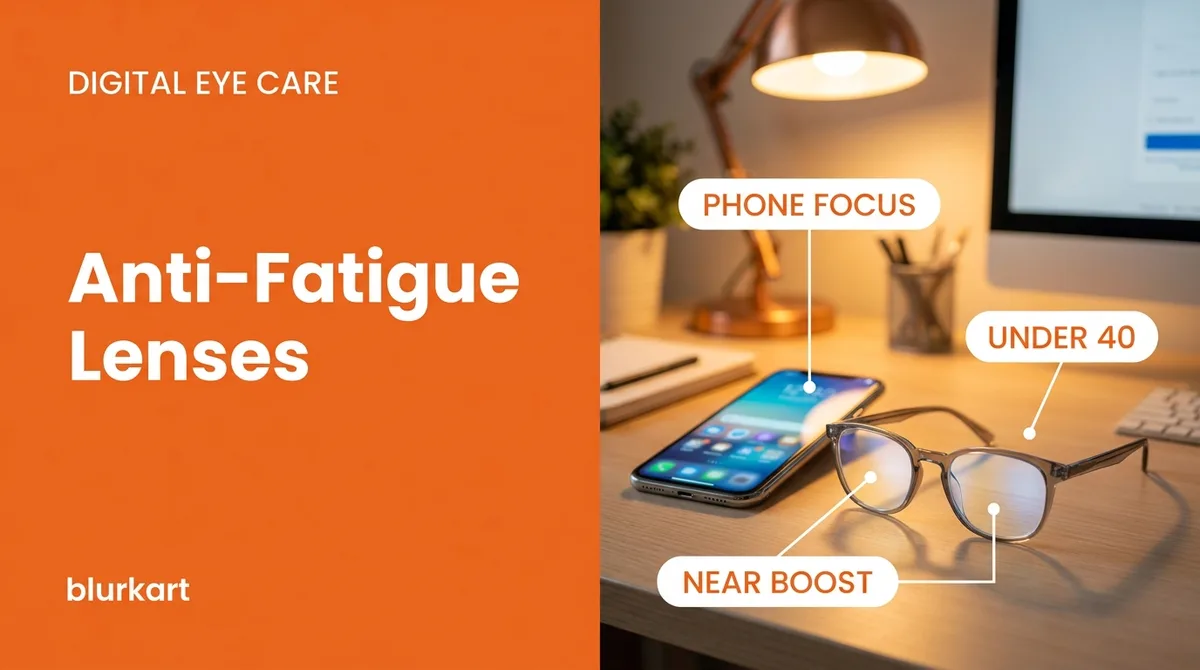
Anti-fatigue (digital) lenses are single-vision lenses with a small extra 'boost' of power in the lower part, which relaxes the eye's focusing effort during close screen work. They suit heavy screen users, students and professionals roughly 25 to 45 who get tired, achy eyes but do not yet need reading glasses.
Why your eyes ache even with 'perfect' vision
You are in your late twenties or thirties. Your distance vision is fine, or your current glasses are correct. Yet after a full day on a laptop and a phone, your eyes feel tired, heavy and sore, and the words start to swim. This is digital eye strain, and a large part of it is muscular, not a failure of your prescription.
To focus on something close, a small muscle inside your eye contracts and holds that contraction the entire time you stare at a screen. Do that for eight, ten or twelve hours a day, as many students and IT professionals in Kathmandu do, and the muscle simply gets fatigued. The result is aching and heaviness, not blur, which is why people are often told, confusingly, that their eyes are 'fine'.
What anti-fatigue lenses do differently
Anti-fatigue lenses, also sold as digital or boost lenses, are single-vision lenses with a twist. The upper part carries your normal vision, while the lower part adds a small amount of extra focusing power, a gentle boost, exactly where you look at your phone or keyboard.
That small boost quietly does some of the work your focusing muscle would otherwise do, so the eye relaxes during close tasks. Over a long day, that reduction in effort is what you feel as less fatigue by evening.
Think of it as a very mild, almost invisible reading assist, built for people too young for reading glasses but too screen-heavy to ignore the strain.
How they differ from the lenses you already know
| Lens | What it changes | Who it is for |
|---|---|---|
| Ordinary single-vision | Corrects your vision only | Everyone needing correction |
| Blue-cut | Filters some screen light | Heavy screen users wanting a filter |
| Anti-fatigue (digital) | Adds a small near boost to relax focusing | Screen-heavy under-40s with tired eyes |
| Progressive | Full reading power for presbyopia | Usually over 40 |
A day in the life, with and without
Picture a developer in Kathmandu. Without anti-fatigue lenses, the morning is fine, but by mid-afternoon the code starts to blur slightly, the eyes feel gritty, and a dull ache sets in behind the brow by evening. With anti-fatigue lenses, that same close work asks less of the focusing muscle, so the afternoon dip is gentler and the evening ache is smaller. The vision is not sharper in the morning; the difference is how the eyes feel after many hours.
Who should consider them
These lenses suit you if you are roughly 25 to 45 and:
- Spend most of the day on screens for work or study.
- Feel tired, achy or dry eyes by evening rather than blurred vision.
- Are a developer, designer, student, accountant or anyone doing long close work.
- Do not yet need, or do not want, full reading glasses.
They are a comfort upgrade, not a medical treatment, so set expectations accordingly. They make a long screen day easier; they do not cure an underlying eye condition, and they are not a substitute for an eye test.
How to trial them, and know they are working
Give a new pair about two weeks of normal use. The sign to look for is not a dramatic jump in sharpness, it is that your eyes feel less tired at the end of a heavy screen day than they used to. If evenings are easier and the dull ache fades, they are doing their job. If nothing changes at all, go back for a recheck, because the cause of your strain may be something else, such as dry eye or an outdated distance prescription.
Get the most out of them
A lens can only do so much if your habits fight it. Pair anti-fatigue lenses with:
- A quality anti-reflective coating to cut screen and overhead-light glare.
- The 20-20-20 rule: every 20 minutes, look 20 feet away for 20 seconds.
- A screen at arm's length and slightly below eye level.
- Decent lighting, so you are not straining in a dark room with one bright screen.
Getting them in Nepal
Start with an eye test, and mention how your eyes feel after screens, not only how well you see the chart. If tired eyes are the main complaint, ask whether an anti-fatigue lens is right for you. You can order them in your preferred frame, with a blue-cut and anti-reflective coating added, and give your focusing muscles the break they have been quietly asking for.
Frequently asked
- What is the difference between anti-fatigue lenses and blue-cut lenses?
- They solve different problems. Blue-cut lenses filter some screen light. Anti-fatigue lenses change the optics by adding a small near boost to ease focusing effort. Many people choose anti-fatigue lenses with a blue-cut and anti-reflective coating together.
- Do I need a prescription for anti-fatigue lenses?
- They are available both with your distance prescription built in and as a near-only boost for people who otherwise see fine. An eye test will confirm which suits you.
- Are anti-fatigue lenses the same as progressives?
- No. Progressives are for presbyopia (usually over 40) and carry a full reading power. Anti-fatigue lenses carry only a small boost and are aimed at younger heavy screen users whose eyes tire from constant close focus.
- Will I notice the boost zone?
- Most people do not see any line or jump. The boost is gentle and sits in the lower part of the lens where you naturally look for screens and reading.
- Can students use anti-fatigue lenses?
- Yes. Students who study long hours on books and screens are good candidates, especially during exam season when close work spikes. They are a comfort upgrade, not a treatment, so they pair best with good study habits and lighting.