
ZEISS SmartLife Digital Lenses for Screen-Heavy Eyes
ZEISS SmartLife Digital lenses are single-focus-style lenses with a specially optimised near zone, made for people who spend long hours on phones and laptops. They are aimed at wearers from about their mid-30s. ZEISS reports 73% of wearers perceived less eye strain at the end of the day in its studies.
Quick answer
ZEISS SmartLife Digital lenses are designed for people who focus on screens for hours. They keep a wide distance zone and add a specially optimised near zone so close work feels less tiring. ZEISS recommends them from around the mid-30s.
Small text, endless scrolling and constant switching between phone, laptop and the room around you all ask a lot of your focusing muscles. In your mid-30s, you may notice your eyes feel tired and vision softens, especially late in the day. That is the group ZEISS Digital lenses are built for.
How the lens works
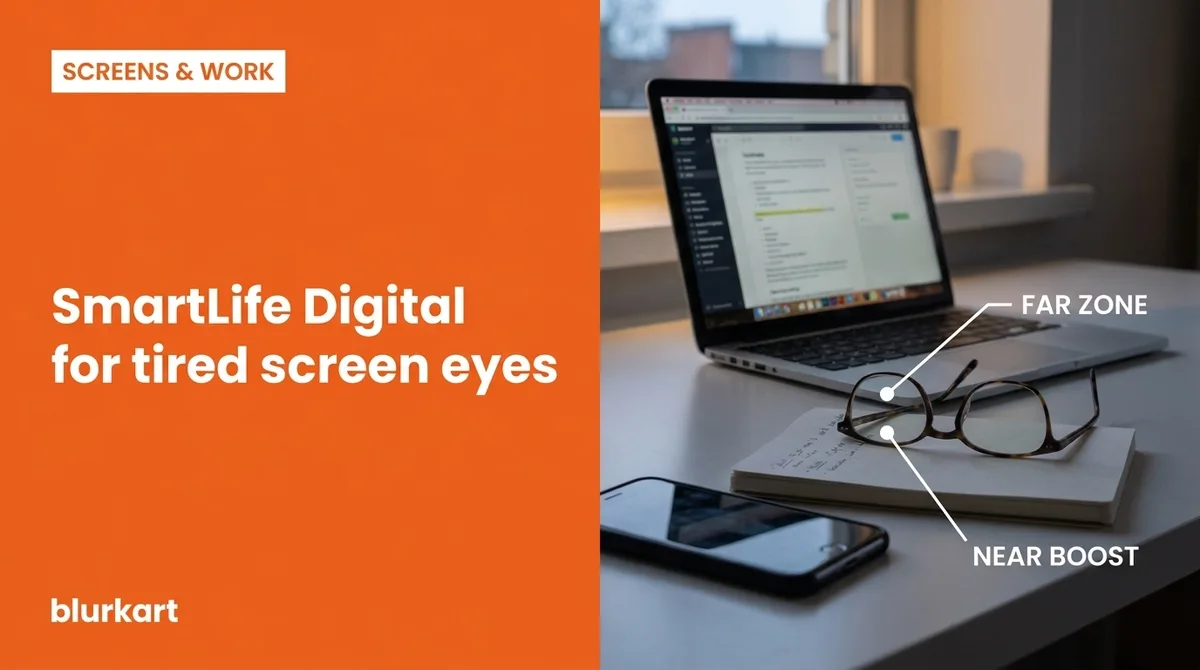
A normal single vision lens gives the same power across the lens. A digital lens keeps a large, clear distance zone but adds help for close-up tasks in the lower part of the lens, so your eyes have to work less to focus on near objects. Unlike a full progressive, the change is gentle, so most people do not notice a visible transition.
What ZEISS reports
- 73% of wearers perceived less eye strain at the end of the day, according to ZEISS's consumer testing.
- The latest design has up to 8% wider fields of clear view, tuned to the wearer's visual demand, compared with the previous ZEISS SmartLife Digital lenses.
- An external study of 30 to 40 year olds found improved focusing response after a concentrated near task, compared with standard single vision lenses.
These are manufacturer-reported results, and individual experience varies.
A stepping stone to progressives
Many people eventually need progressive lenses as presbyopia develops. ZEISS says its Digital SmartLife design is geared to Progressive SmartLife lenses and has lower overall blur than earlier digital designs, so moving to progressives later can feel more natural.
Who should look at something else
- If you already struggle to read with your distance glasses, ask about progressive or office lenses.
- If you work only at close range and rarely look into the distance, an office lens may suit better.
- If your tired eyes come with red, dry or painful eyes, see an eye doctor, because lenses will not solve everything.
Add-ons that pair well
ZEISS suggests combining Digital lenses with BlueGuard for blue light blocking or PhotoFusion X for self-tinting, plus a DuraVision coating for easier cleaning. Blue light lenses are a personal choice, and research on their effect on strain is mixed, so ask your optician for an honest view.
Wondering whether your eyes need a digital boost? Book a free eye test at Blurkart.
Figures are reported by ZEISS from its own and commissioned studies. Availability varies by market.
Frequently asked
- What is a digital lens?
- It is a lens with a large distance area and an optimised near zone, designed to help your eyes focus at close range with less effort during long screen sessions.
- Who should wear ZEISS SmartLife Digital lenses?
- ZEISS suggests them for people in their mid-30s and up whose eyes get tired from small text and constant focus switching, especially toward the end of the day.
- Are digital lenses the same as progressives?
- No. Digital lenses are for pre-presbyopia and give a gentle near boost. Progressive lenses are for presbyopia and give a full range from distance to reading.
- Will they help me switch to progressives later?
- ZEISS says the Digital SmartLife design is geared to its Progressive SmartLife lenses so the transition to progressives can be easier at a later stage.
- Do digital lenses fix every case of eye strain?
- No. Strain can come from an outdated prescription, dry eyes, poor lighting or posture. A proper eye test is the first step.