
What an optician actually does when adjusting glasses
Adjusting glasses means four things: bending the temple tips behind the ear, setting the pantoscopic tilt of the fronts, aligning the nose pads, and levelling the frame. Each affects where you look through the lens, so a badly fitted pair makes a correct prescription behave like a wrong one. It is free at both showrooms.
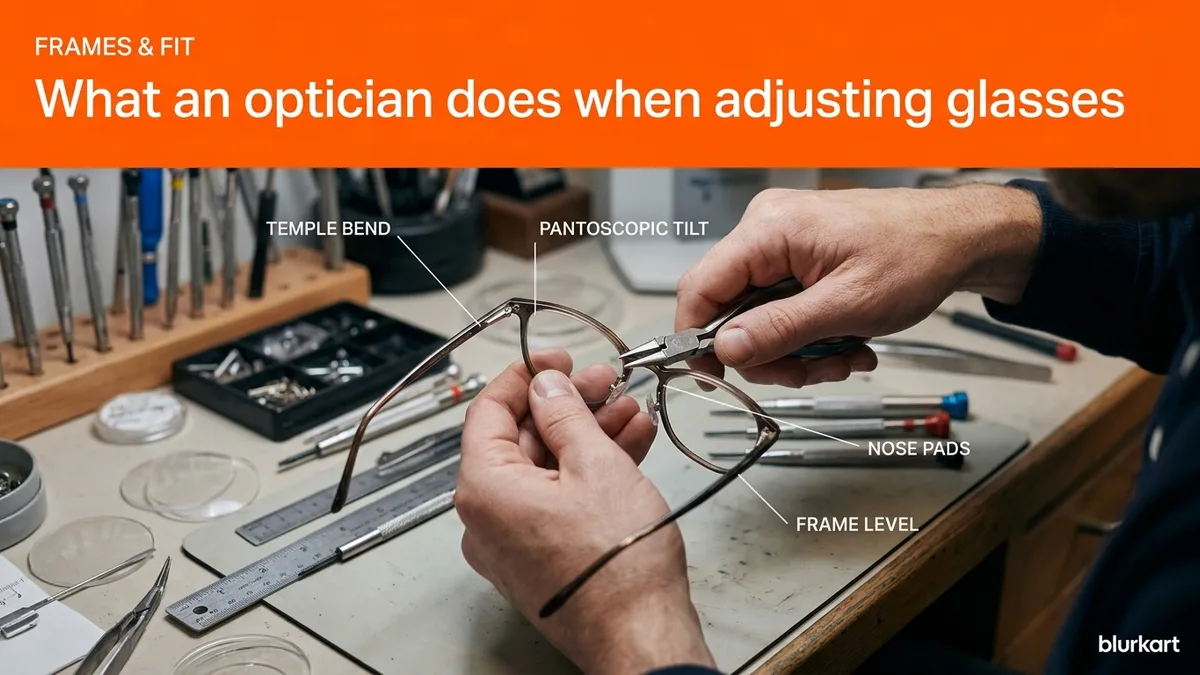
Adjusting glasses looks like an optician casually bending some metal for thirty seconds. What is actually happening is four separate corrections, and each one changes where your eye sits relative to the lens.
The four parts of adjusting glasses
Temple bend. The last few centimetres of each arm should curve down and follow the shape behind your ear, touching along a length rather than pressing at one point. Too straight and the frame slides forward. Too tight and you get a headache behind the ear within an hour. Both arms have to match, because ears are rarely at the same height and the bend compensates.
Pantoscopic tilt. This is how far the bottom of the lens leans in towards your cheek. Most frames want roughly eight to twelve degrees. Get it wrong and you look through the lens at an angle it was not ground for, which introduces distortion, most noticeably in progressives.
Nose pads. Each pad should lie flat against the skin along its whole length so the weight spreads. Angled pads dig in with one edge, which is what produces the red marks.
Frame level. The fronts should be horizontal when you look straight ahead. A frame that sits low on one side puts your eye above the optical centre on that side, which produces a subtle prismatic effect and, over a day, a headache you would never connect to your glasses.
Why it matters more than it sounds
A lens is ground on the assumption that your pupil sits at a particular point, at a particular distance from the lens, at a particular angle. Every one of the four adjustments above moves you relative to that assumption.
So a correct prescription in a badly sitting frame behaves like a wrong prescription. People come in convinced the power is off, and often the power is perfect and the frame has simply worked loose over six months. That is the first thing we check, before touching the refractor.
This is also why a new pair can feel wrong for reasons that have nothing to do with the lens.
Why not to do it yourself
Nose pads you can nudge gently. Beyond that, the risk outruns the saving.
Acetate has to be warmed before it will bend, and the window between pliable and ruined is narrow. Too cool and it cracks, too hot and the surface goes cloudy and never recovers. We use a warm air blower and we are doing it for the hundredth time this month.
Metal fatigues. Each bend at the same point weakens it, and the arm eventually snaps there, usually at the hinge where it is hardest to repair. A frame that has been adjusted at home five times is measurably closer to failing than one adjusted properly once.
Rimless frames are the worst case. Bending anything near the mount transfers stress into the drilled hole in the lens, and that crack is a new lens rather than a repair.
It costs nothing here
Adjustments, nose pads and temple tips are free at both showrooms, Pulchowk in Lalitpur and Boudha in Kathmandu, on any frame, whether it came from us or not. We do not ask for a receipt.
The reason is straightforwardly self-interested. Badly fitting glasses get blamed on the lens, then on the shop, and a five-minute adjustment prevents most of that. Come in whenever the pair starts sliding rather than waiting for your next test. If the frame turns out to be the wrong size for your face, frames start at NPR 999 and we will measure you properly first.
What to tell us when you come in
Describe the symptom rather than diagnosing it. Saying the pair slides down when you look at your phone, or that your right ear aches by evening, or that things look fine straight ahead but tilt at the edges, tells us where to start. Saying you think the power is wrong sends us to the refractor first, which is often the slower route.
Wear the glasses in rather than carrying them, so we can see how they actually sit on you. And mention anything that changed: a new haircut that alters how the arms sit, a period of wearing them pushed up on your head, a bag they have been loose in.
Five minutes at the counter fixes a large share of what people assume needs a new prescription.
Frequently asked
- Can I adjust my glasses at home?
- Small nose pad tweaks, carefully, yes. Heating and bending the front is where people crack acetate or snap a hinge. Metal fatigues if bent repeatedly, so each home attempt makes the next one riskier.
- How often should glasses be adjusted?
- Whenever they start sliding, sitting crooked or marking your nose. Realistically every few months, because frames loosen gradually with normal handling and you stop noticing.
- Chasma khaskiirakheko chha, milaunu parchha?
- Parchha, ra nihsulka chha. Duitai showroom ma lyaunus, hami kaan pachhadi ko bhag, agadi ko jhukav ra nose pad milai dinchhau. Arkai pasal bata kineko bhaye pani hunchha.