
ZEISS SmartLife Lenses Explained: The Whole Family
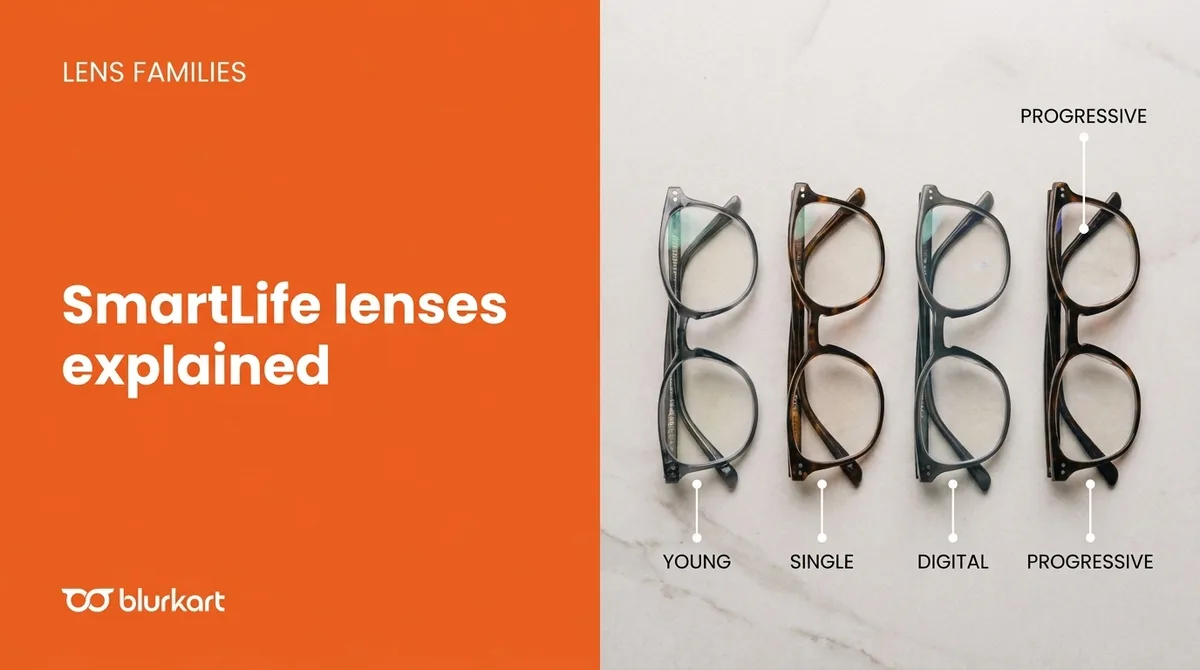
ZEISS SmartLife is a lens portfolio built around how people really use their eyes today, switching constantly between screens and the real world. It has four branches: Young for children and teens, Single Vision, Digital for the 30s and up, and Progressive for presbyopia. Age-related design is built into all of them.
Quick answer
ZEISS SmartLife is a family of lenses for modern life, where our eyes jump between phone, laptop, road and real world all day. It has four branches: Young, Single Vision, Digital and Progressive.
Most lens brands sell a long list of products. ZEISS SmartLife organises them by life stage, so the lens grows with you. Here is how the family fits together.
The four SmartLife branches
| Lens | Who it is for | What it does |
|---|---|---|
| SmartLife Young | Children and teens, about 6 to 19 | Design adapted to a growing face and changing pupil size |
| SmartLife Single Vision | Anyone needing distance or near correction | One prescription with larger clear fields of view |
| SmartLife Digital | Screen-heavy adults, usually mid-30s and up | Extra help at near distance to reduce end-of-day strain |
| SmartLife Progressive | People with presbyopia | Distance, intermediate and near vision in one lens |
What makes them 'smart'
ZEISS builds SmartLife on a technology it calls SmartView. Rather than optimising only for straight-ahead vision, the design considers how you actually look at things: glancing down at a phone, up at a sign, across to a colleague. It also takes age into account, including how pupil size and viewing habits change over a lifetime, which ZEISS calls Age Intelligence.
The top tier, SmartLife Individual 3, goes further. It combines this age-related behaviour data with your personal measurements using what ZEISS calls Intelligence Augmented Design.
Built in, and add-ons
- UV protection: ZEISS says sunglass-level UV protection is included in every SmartLife lens.
- Thin and flat design: pair it with the lens material and index that suits your prescription.
- Optional extras: BlueGuard for blue light blocking, PhotoFusion X for self-tinting, and a DuraVision coating for scratch resistance and easy cleaning.
How to choose
- Start with your age and the problem you want solved: distance blur, screen strain or reading difficulty.
- Pick the branch that matches, then ask whether a higher tier is worth it for your prescription and frame.
- Add coatings and extras based on how you live, such as long screen hours or lots of time outdoors.
We will cover each SmartLife branch in detail in this series. To find out which one fits you today, book a free eye test at Blurkart.
Information is based on ZEISS product pages. Specific lens designs and availability vary by market; confirm with your optician.
Frequently asked
- What is ZEISS SmartLife?
- SmartLife is a ZEISS lens portfolio designed for dynamic, screen-filled daily life. It covers four types: SmartLife Young, Single Vision, Digital and Progressive.
- Who is each SmartLife lens for?
- Young is for children and teens aged roughly 6 to 19. Single Vision corrects distance or near vision. Digital suits people who strain at screens, typically from the mid-30s. Progressive is for presbyopia, when you need distance and near vision in one lens.
- What does Age Intelligence mean?
- ZEISS adapts the lens design to the typical visual needs and eye anatomy of each life stage, so the lens changes as you grow older rather than treating every wearer the same.
- Is SmartLife a freeform lens?
- ZEISS says SmartLife lenses use a freeform design, unlike most single vision lenses sold worldwide.
- Can I add blue light protection or self-tinting?
- Yes. ZEISS offers BlueGuard for blue light blocking and PhotoFusion X for self-tinting lenses as add-ons across the SmartLife range.