
Contact lens solution: multipurpose or peroxide?
Multipurpose solution cleans, rinses and disinfects in one bottle and suits most wearers. Hydrogen peroxide systems disinfect more thoroughly and contain no preservatives, which helps sensitive eyes. Peroxide must neutralise in its own special case for the full time, because putting un-neutralised peroxide in your eye causes a chemical burn.
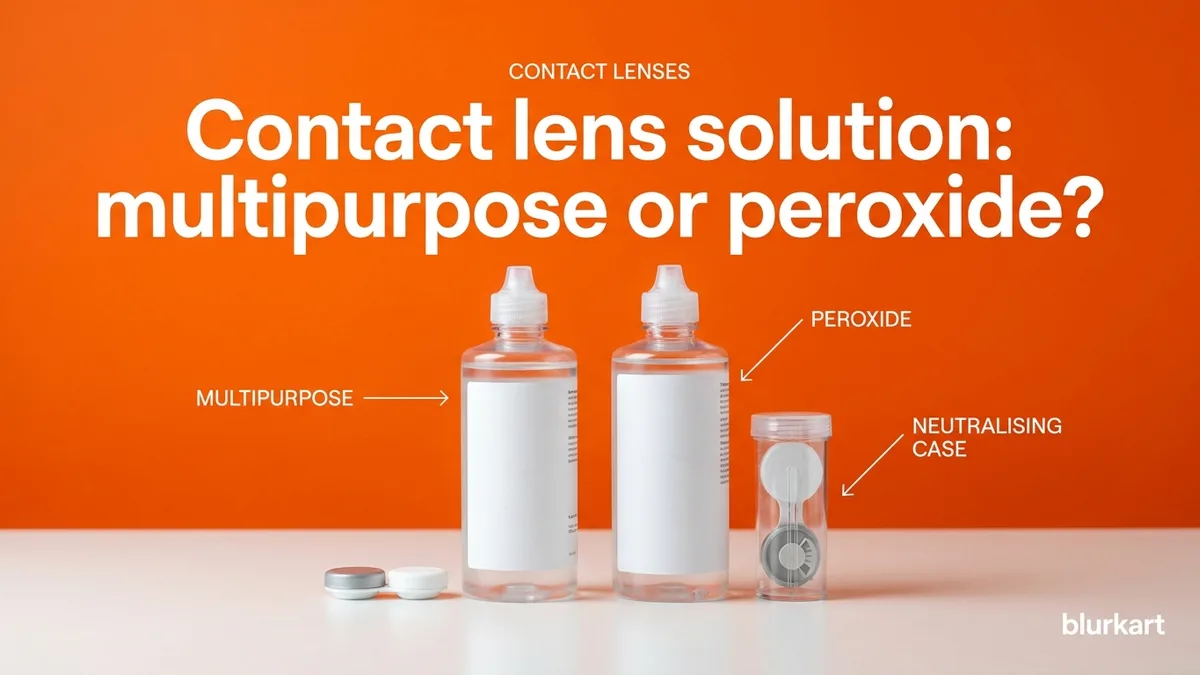
Choosing a contact lens solution looks like choosing a bottle. It is really choosing a routine, and one of the two options is unforgiving if you get the routine wrong.
Multipurpose contact lens solution
One bottle that cleans, rinses, disinfects and stores. You rub the lens in your palm with a few drops, rinse it, drop it in a flat case with fresh solution, and leave it overnight.
It suits most wearers because the routine is short and nothing can go badly wrong. The trade is that it contains preservatives to keep the bottle sterile after opening, and a minority of people react to those with redness or stinging that gets blamed on the lens.
The step people skip is the rub. Solutions marketed as no-rub still work substantially better with ten seconds of rubbing, because that is what physically removes protein deposits rather than chemically treating them.
Hydrogen peroxide systems
Peroxide disinfects harder. It kills a broader range of organisms, including the ones multipurpose solutions handle least well, and it contains no preservatives at all. For anyone whose eyes react to multipurpose, that alone can solve the problem.
It works by sitting in a special case containing a platinum catalytic disc, which converts the peroxide into plain saline over about six hours. When the process finishes, what is left is harmless.
Now the part that matters more than anything else on this page. Un-neutralised peroxide in your eye causes an immediate chemical burn: severe stinging, watering and redness. It is genuinely painful and it can damage the surface.
So three rules, without exception. Use only the case that came with that peroxide system, because the disc is the neutraliser. Leave it the full time, usually six hours, even if you are in a hurry. And never rinse a lens with peroxide straight from the bottle before putting it in, which is the single commonest way people injure themselves with it.
Which one suits you
Take multipurpose if you want the simplest routine, you travel and do not want to track timing, or you have never had a reaction. It is also cheaper and easier to find in Kathmandu.
Take peroxide if your eyes sting or redden with multipurpose, if you have sensitive eyes generally, if you get recurring irritation nobody can explain, or if an optometrist recommended it. Take it also if you are a heavy monthly-lens wearer, since deposits build over thirty days.
Or sidestep the question entirely with daily disposables, which need no solution or case at all. For occasional wearers that is usually the cheaper and safer answer, and the real monthly cost comparison works it out.
The rules that apply to both
Never tap water. Not for rinsing lenses, not for rinsing the case. Water can carry Acanthamoeba, an organism that causes a rare but devastating corneal infection, and contact lenses are its main route in.
Never top up. Old solution in the case has already been used and is no longer reliably sterile. Empty it, rinse the case with fresh solution, air dry it face down.
Replace the case monthly. It is the cheapest thing in the routine and the dirtiest object in most bathrooms.
Respect the discard date on the bottle after opening, typically 90 days, and check the expiry. We stock solutions and cases at both showrooms alongside lenses from NPR 1,100, and the full contact lens guide covers fitting.
Travelling with either system
Multipurpose travels easily. Buy a small bottle rather than decanting into an unlabelled container, because a decanted solution is no longer guaranteed sterile and airport security dislikes unlabelled liquids.
Peroxide travels less easily. It needs the full neutralising time before the lenses are safe, so an overnight bus or an early flight can leave you with lenses that are not ready. Plan the timing, or carry a day of dailies as backup for exactly those days.
For a trek, dailies remove the problem entirely: no case, no solution, no water anywhere near your lenses. Given that tap and stream water are the main route for the organism that causes the worst contact lens infection, that is a real safety argument and not just convenience. Daily vs monthly works out the cost.
Frequently asked
- Can I swap between multipurpose and peroxide?
- Yes, but never mix them in the same case and never use the flat multipurpose case for peroxide. Peroxide only neutralises in the special case with the catalytic disc, and the wrong case means a chemical burn.
- Is saline the same as contact lens solution?
- No. Saline rinses but does not disinfect. Storing lenses in saline overnight leaves them unsterilised. It is a rinse, not a soak.
- Lens solution ko saatho paani prayog garna milchha?
- Kahile pani milddaina. Dharako paani ma Acanthamoeba nam ko jeevanu huna sakchha jasle aankha lai gambhir kshati puryauchha. Purano solution ma naya thapnu pani hunna, hareka pali pheri naya halnus.